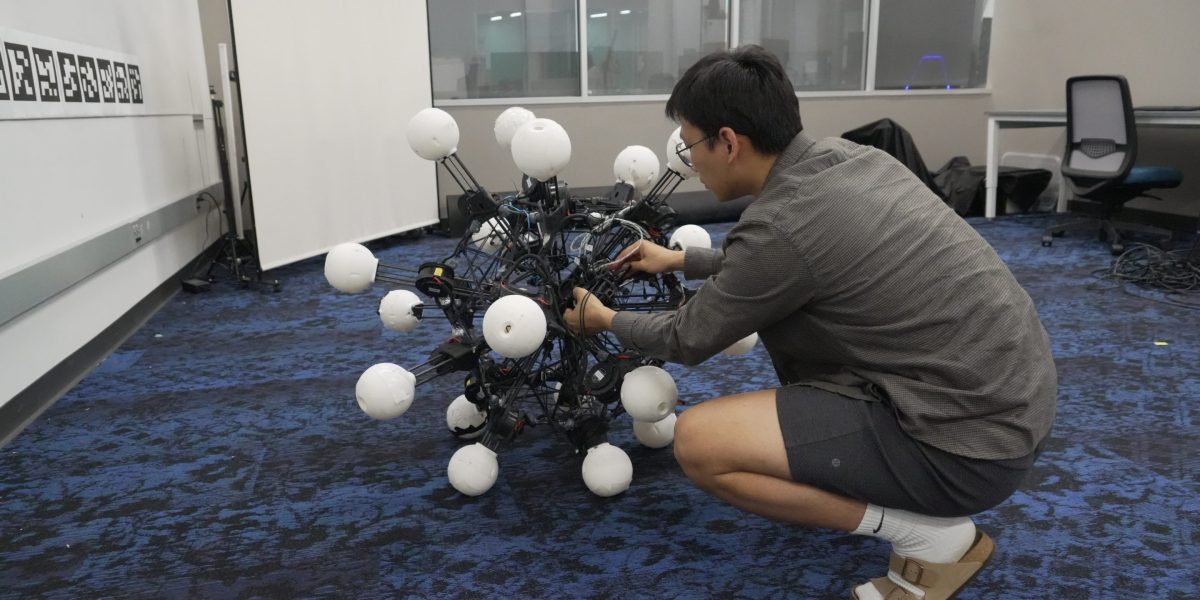
Argus is a roly-poly robot built around dynamic symmetry rather than human or animal-like appearance. It has depth-sensing cameras attached to 20 telescoping legs radiating from a central core, with no defined front, back, top, or bottom. This design lets it see and move instantly in any direction. Experiments show it can navigate sandy beaches and forest undergrowth, roll over obstacles, stabilize after being pushed, and climb between parallel brick walls by alternating bracing and thrusting motions. It can keep functioning even if one or more motors die or a leg breaks. A design principle called dynamic isotropy rates robots by how uniformly they accelerate in every direction, and Argus scores 0.91.
"Instead of trying to copy symmetrical shapes from nature by building robots that look like people, dogs or insects, engineering professor Boyuan Chen and his team focused on uniformity in action, or what he calls "dynamic symmetry." The result was Argus. The roly-poly robot named after a mythological many-eyed giant has depth-sensing cameras attached to 20 telescoping legs that radiate from a central core. With no front, back, top or bottom, it can see and move in any direction instantly."
""Instead of measuring how your legs are arranged around a different part of your body, we're measuring how fast you can move in any direction," Chen said. "Who said, you know, if you have a robot to help us in a most effective way, it has to look like us?" In experiments, Argus has navigated sandy beaches and forest undergrowth, rolling over obstacles and stabilizing itself after being pushed."
"It can climb between parallel brick walls by alternating bracing and thrusting motions with its legs. If one or more motor dies or a leg breaks, it continues to function. "Watching Argus move is unlike watching any other robot we've worked with," said Jiaxun Liu, a graduate student and co-author of a study about Argus published online Wednesday in the journal Science Robotics. "The first time we saw it navigate among trees and rough terrain, even under heavy collisions, we knew this was something different.""
"As part of their work, researchers developed a new design principle called dynamic isotropy that rates robots on a scale of 0 to 1 based on how uniformly they can accelerate in every direction. Most robots in use today, including humanoids and drones, score below 0.6. Argus scores 0.91. "When a robot can accelerate equally well in every direction, it stops needing to face the world in any particular way," Chen said."
Read at Fortune
Unable to calculate read time
Collection
[
|
...
]