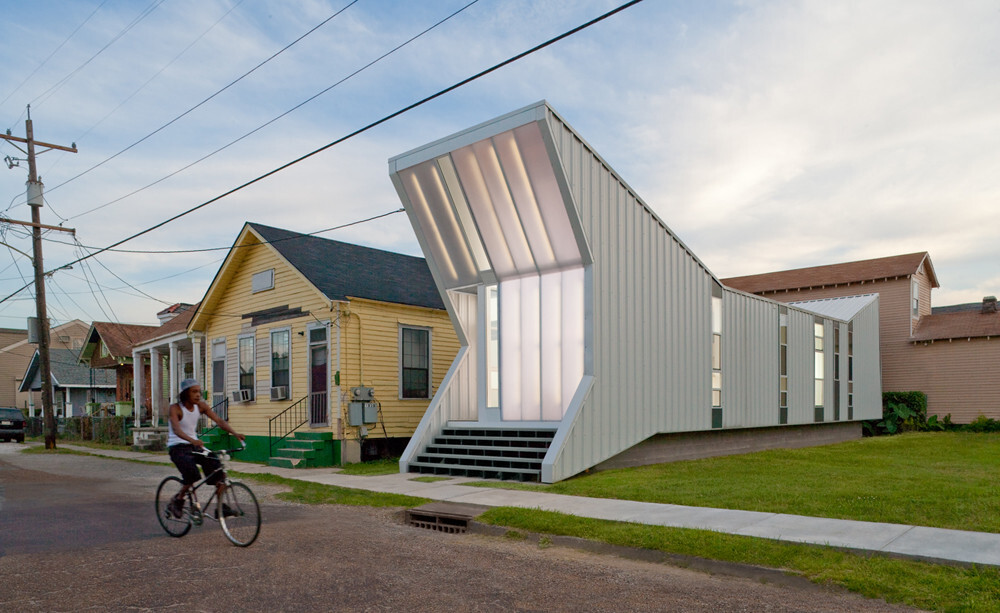
Shotgun houses emerged in port cities and working-class neighborhoods during the nineteenth century, offering an economical response to density, climate, and limited urban parcel sizes. Their narrow footprint, sequential interior plan, and deeply shaded porches created a spatial logic suited to environmental conditions. These houses became common across the Southern United States, forming neighborhood fabric in places such as New Orleans, Mobile, Houston, and Louisville. In the 1960s and 1970s, federal redevelopment programs, highway construction, and modernization efforts targeted these neighborhoods through urban renewal. Shotgun houses were treated as symbols of overcrowding and economic decline, leading to widespread demolition. The resulting displacement disproportionately affected Black communities and disrupted long-standing social networks. Today, the typology has regained architectural attention in the South.
"Urban renewal planners and politicians dismissed shotgun neighborhoods as symbols of poverty and substandard housing, demolishing thousands of structures in the name of progress. The destruction disproportionately displaced Black communities and erased local social networks that had evolved over generations within the intimate scale of shotgun neighborhoods."
#shotgun-houses #urban-renewal #southern-architecture #climate-responsive-design #displacement-and-civil-rights
Read at ArchDaily
Unable to calculate read time
Collection
[
|
...
]