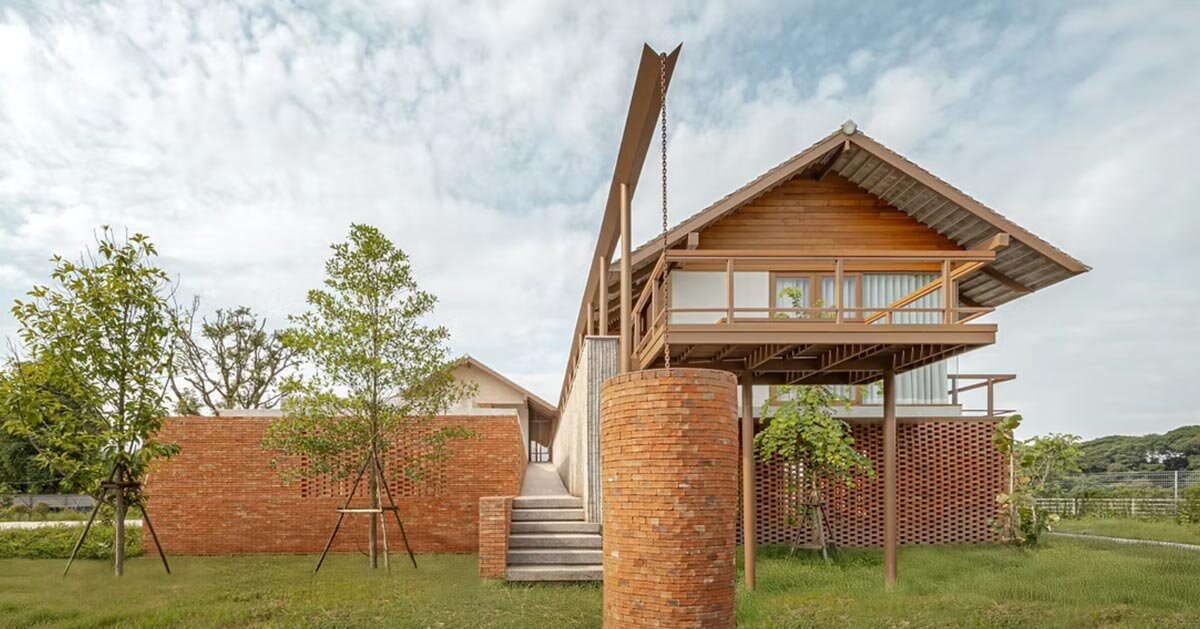
"The building is oriented along a north-south axis to reduce solar exposure and align with prevailing environmental strategies found in traditional models. The gable end faces south, establishing visual connections to the river and surrounding mountains while maintaining controlled exposure to sunlight."
"The house is elevated above ground level, improving natural ventilation, reducing heat gain, and creating a shaded undercroft that accommodates service functions and additional uses. The program is divided into two primary volumes following a 'twin-house' configuration, separating sleeping areas from kitchen and service spaces."
"The two volumes are connected by a continuous gutter system that collects rainwater and directs it into brick reservoirs positioned at either end of the house, enabling reuse for irrigation."
Baan SudSaenSuk in Chiang Saen reinterprets Lanna vernacular architecture by adapting the Ka Lae house typology through contemporary design principles. The building employs a north-south orientation to minimize solar exposure and incorporates traditional climatic strategies. The structure is elevated to enhance natural ventilation and reduce heat gain, with an undercroft providing service functions. The design uses a twin-house configuration separating sleeping areas from kitchen and service spaces to improve functional clarity and limit heat transfer. A continuous gutter system collects rainwater into brick reservoirs for irrigation reuse. The site orientation avoids direct alignment with adjacent walkways, using landscape elements as visual buffers. Transitional spaces including outdoor terraces and semi-open halls function as intermediary environmental zones.
#lanna-vernacular-architecture #contemporary-reinterpretation #climate-responsive-design #twin-house-typology #sustainable-water-management
Read at designboom | architecture & design magazine
Unable to calculate read time
Collection
[
|
...
]