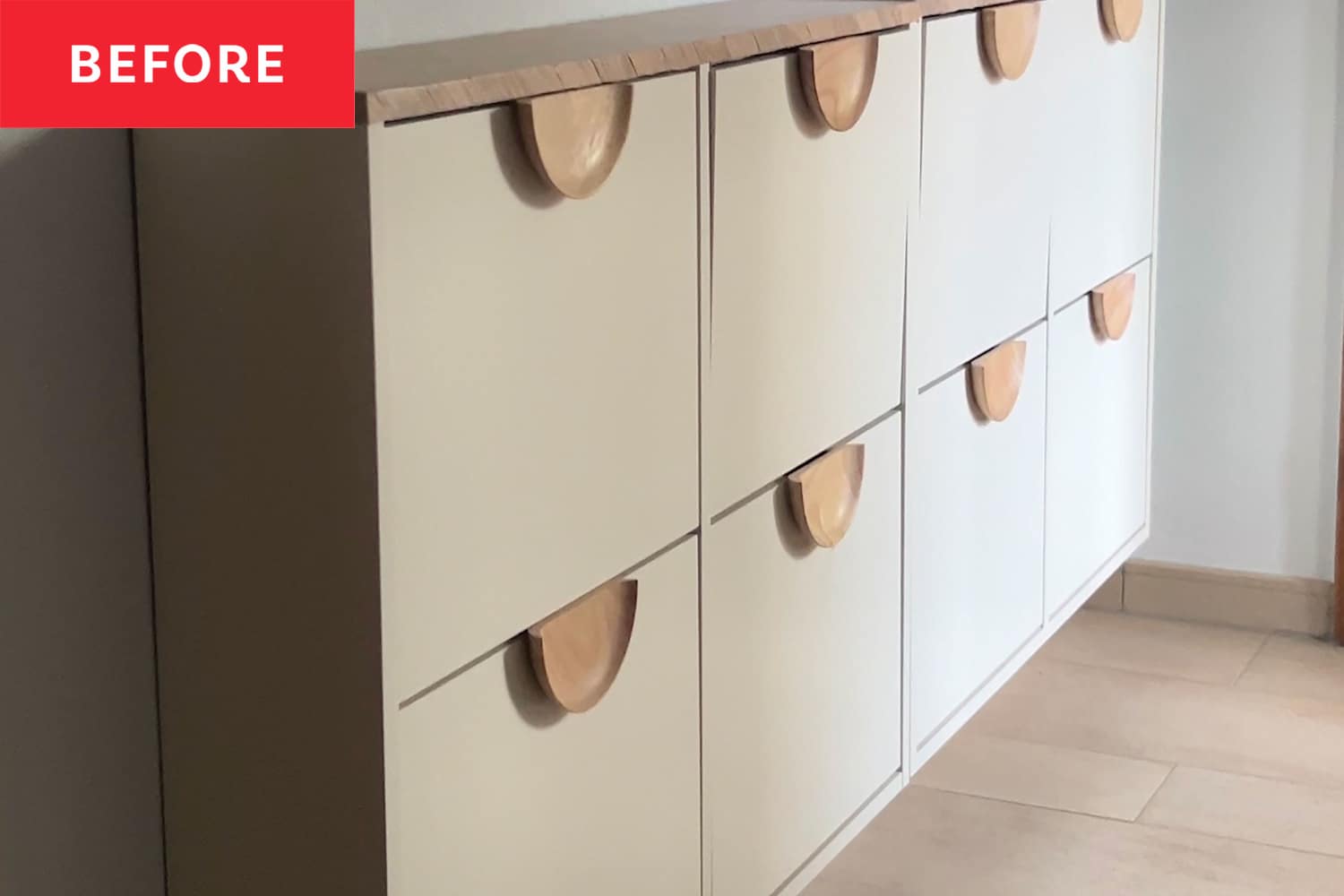
"The first step was to remove all traces of past upgrades. Mariana began by returning the cabinets to their original forms; she removed old handles and cleaned off all previous DIY elements. The biggest transformation came from adding thin plywood panels to craft a clean, minimalist, Japandi-inspired aesthetic. She also upgraded the withe edges of the cabinets with wood-look edge banding to cover small dings and white areas from the original cabinet, because she gave the piece an all-over wood look."
""I cut and sanded the wood panels, attached them to the cabinet, and finished the surface with Osmo hardwax oil to achieve the warm, natural tone," Mariana explains. She used a mixture of 10 parts Osmo Hartwachs' Bernstein mixed with one part Osmo Hartwachs' Terra. This process gave the wood a deep, custom hue. One of the hardest parts of the project was tinting the edge banding this same hue."
"The project cost about $140. Mariana spent around 120€, or $140 USD, for the entire project (70€ for the wood, 30€ for contact paper, plus a small cost for glue and screws). "It feels amazing that such a simple and budget-friendly update could transform an old piece into something that looks like a custom design item," Mariana concludes. "Every time I walk past it, it just feels more intentional and aligned with th"
Two IKEA shoe cabinets were transformed from plain white units into a Japandi-style, wood-look entryway feature. Old handles and previous DIY elements were removed, and thin plywood panels were cut, sanded, and attached to add texture and a minimalist aesthetic. Wood-look edge banding covered dings and remaining white edges for an all-over wood appearance. Surfaces were finished with a custom-mixed Osmo hardwax oil (10 parts Bernstein to one part Terra) to achieve a warm, deep hue. Tinting the edge banding to match presented a challenge. Total material cost was approximately 120€ (about $140).
Read at Apartment Therapy
Unable to calculate read time
Collection
[
|
...
]