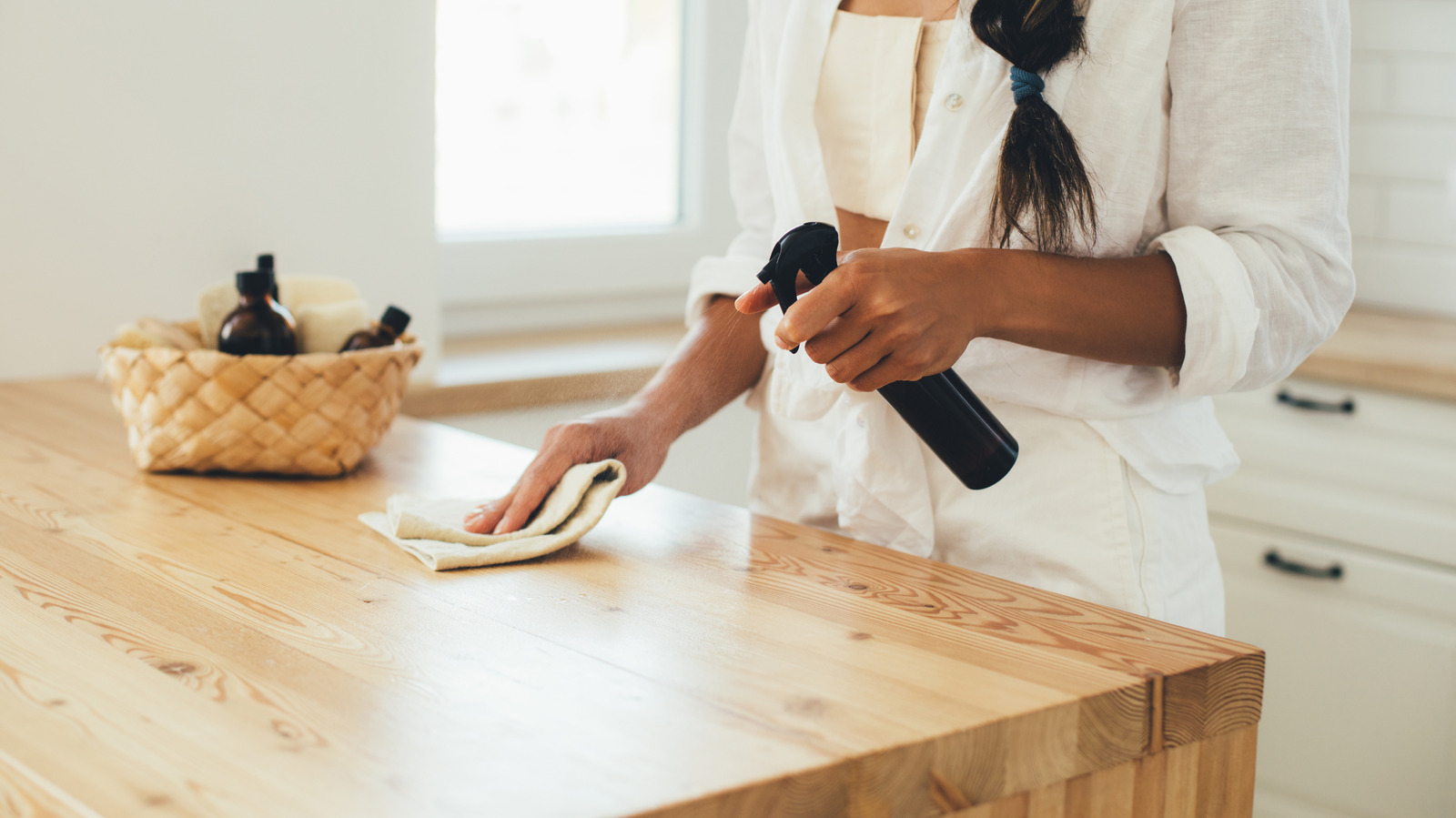
"As something everyone has a bottle of in their pantry, vinegar is a classic household cleaner. But while it can be great for glass or cast iron, it's best avoided when cleaning wood products, especially those that have been finished. That's because vinegar is an acidic liquid, and a strong one at that. While a mixture of vinegar and water is great at cutting through grease, the acid can also wear away at surfaces it's used on repeatedly."
"Vinegar can wear down and corrode finished surfaces like wood and marble Luis Echeverri Urrea/Shutterstock Wood isn't the only surface you want to avoid cleaning with vinegar. The acid has the same problem with many finished stone surfaces that are popular as kitchen countertop materials. Smooth marble, limestone, and soapstone can all have their sheen corroded by vinegar. In fact, vinegar can actually start to dissolve the stone itself. Some countertops, like granite, are more resistant, but can still lose their finish, which will"
Vinegar is an acidic household cleaner effective at cutting grease and useful on glass or cast iron, but repeated use can damage finished wood by stripping and dulling its sheen. Unfinished wood, such as cutting boards, is less vulnerable but still requires heavy dilution; a recommended ratio is two parts water to one part vinegar. The same acidity corrodes many finished stone countertops—smooth marble, limestone, and soapstone—by eroding their sheen and potentially dissolving the stone. Some granite resists acid better but can still lose its finish with repeated vinegar exposure.
Read at Tasting Table
Unable to calculate read time
Collection
[
|
...
]