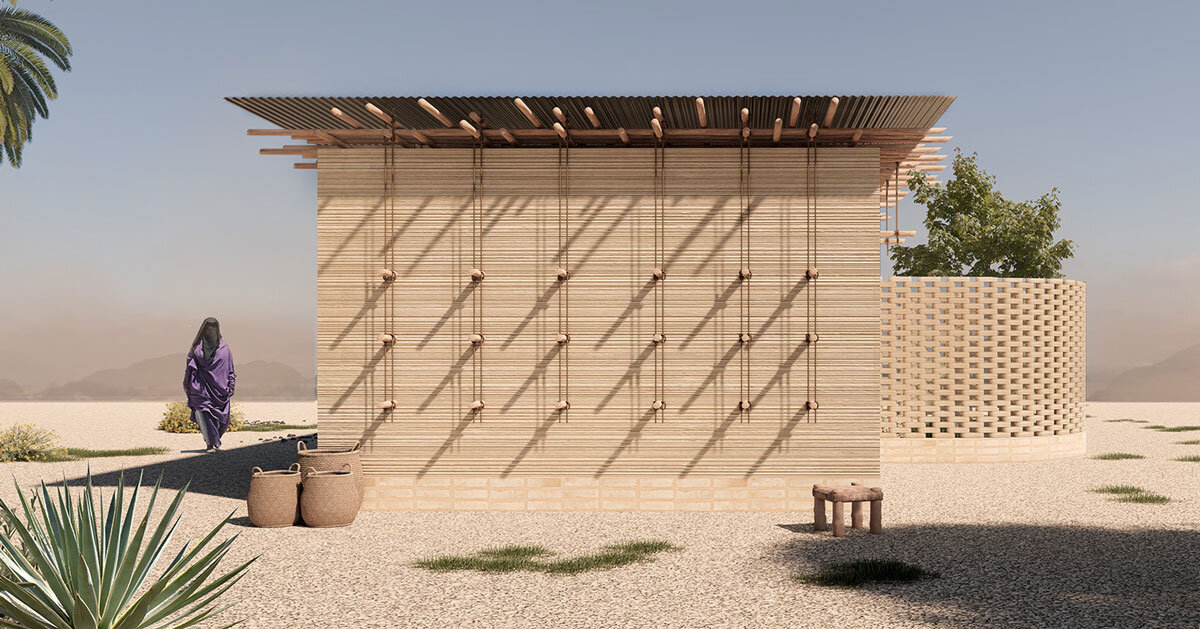
Shelters of the Future proposes a low-cost, culturally grounded shelter system for Somali IDPs built around a flexible 4×4 m spatial module. Each module contains two enclosed rooms, a semi-open central space, and a private garden to preserve dignity, privacy, and cultural spatial norms. Modules cluster into radial, linear, or courtyard arrangements that support organic neighborhood growth and allow transition from emergency response to long-term living. Construction uses locally sourced, renewable, low-embodied-energy materials such as acacia logs, mud bricks, palm leaves, and earth finishes. The design supports low-tech, self-build assembly to empower residents and strengthen local craftsmanship. The concept won first prize in an international competition.
"Rooted deeply in Somali vernacular architecture, the concept reinterprets traditional building knowledge through a contemporary, community-driven framework. The design is anchored by a flexible 4×4 m spatial module, a simple, human-scaled unit that can be organized into diverse configurations. Each module pairs two enclosed rooms with a semi-open central space and a private garden, allowing households to maintain dignity, privacy, and cultural spatial norms."
"The system grows organically, where modules cluster into radial, linear, or courtyard arrangements, forming vibrant neighborhood structures capable of supporting evolving community needs. This adaptability enables shelters to transition from emergency response to long-term, livable environments. Materiality is central to the project's identity. Construction relies on locally sourced, renewable, and low-embodied-energy materials such as acacia logs, mud bricks, palm leaves, and earth-based finishes. The shelter is designed for low-tech, self-build assembly, empowering residents, strengthening local craftsmanship"
Read at designboom | architecture & design magazine
Unable to calculate read time
Collection
[
|
...
]