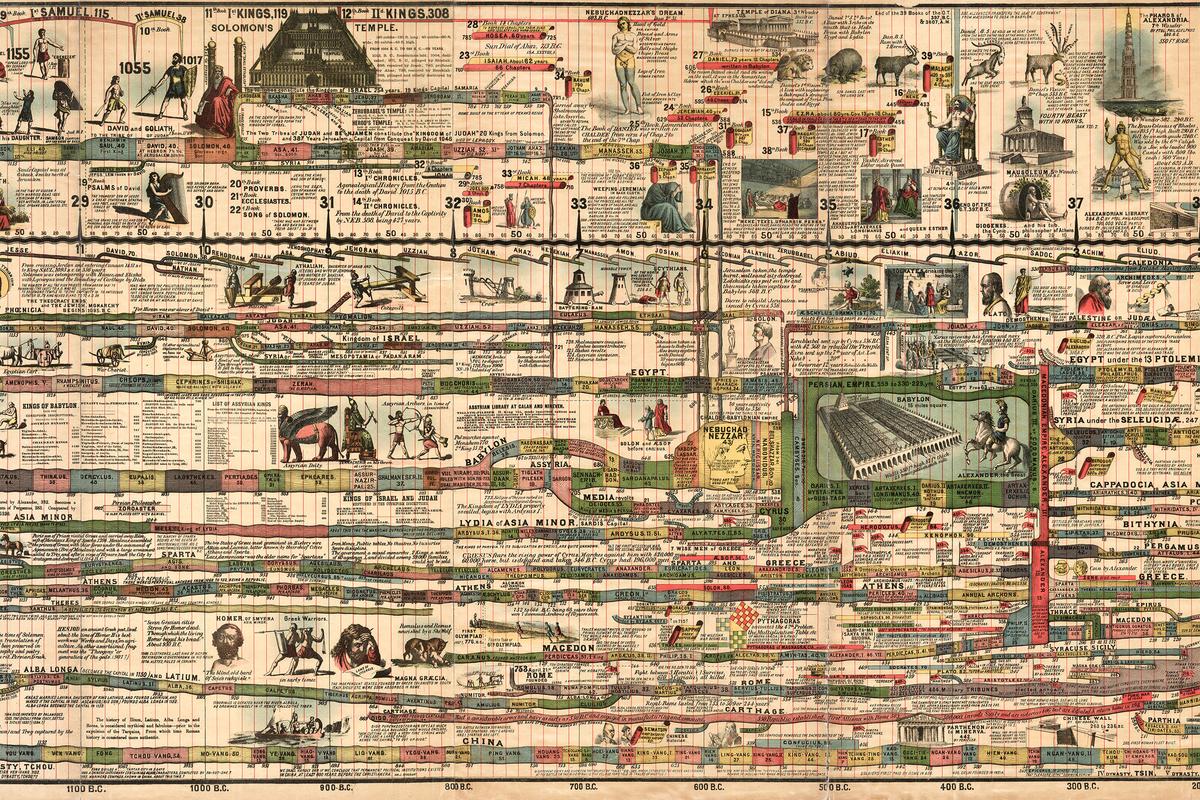
"We imagine the past stretching in a line behind us, the future stretching in an unseen line ahead. We ride an ever-moving arrow - the present. However, this picture of time is not natural. Its roots stretch only to the 18th century, yet this notion has now entrenched itself so deeply in Western thought that it's difficult to imagine time as anything else."
"His creation myth, Timaeus, connected time with the movements of celestial bodies. The god 'brought into being' the sun, moon and other stars, for the 'begetting of time'. They trace circles in the sky, creating days, months, years. The 'wanderings' of other, 'bewilderingly numerous' celestial bodies also make time. When all their wanderings are 'completed together', they achieve 'consummation' in a 'perfect year'."
"For instance, Greek and Roman Stoics connected time with their doctrine of 'Eternal Recurrence': the universe undergoes infinite cycles, ending and restarting in fire. Such views of time are cyclical: time comprises a repeating cycle, as events occur, pass, and occur again. They echo processes in nature. Day and night. Summer to winter. As the historian Stephen Jay Gould explains in Time's Arrow, Time's Cycle (1987), within the West, cyclical conceptions dominated ancient thought."
Modern linear representation of time dates to the 18th century and reshaped Western thought, influencing concepts of history and time travel. Ancient Greek thinkers linked time to celestial motions; Plato's Timaeus describes a god bringing the sun, moon and stars into being for the 'begetting of time', with their circular movements producing days, months and years. Greek and Roman Stoics taught Eternal Recurrence, where the universe undergoes infinite cycles, ending and restarting in fire. Cyclical conceptions of time echoed natural rhythms—day and night, seasons—and dominated Western ancient thought, with scriptural hints such as Ecclesiastes' 'What has been will be again.'
Read at Aeon
Unable to calculate read time
Collection
[
|
...
]