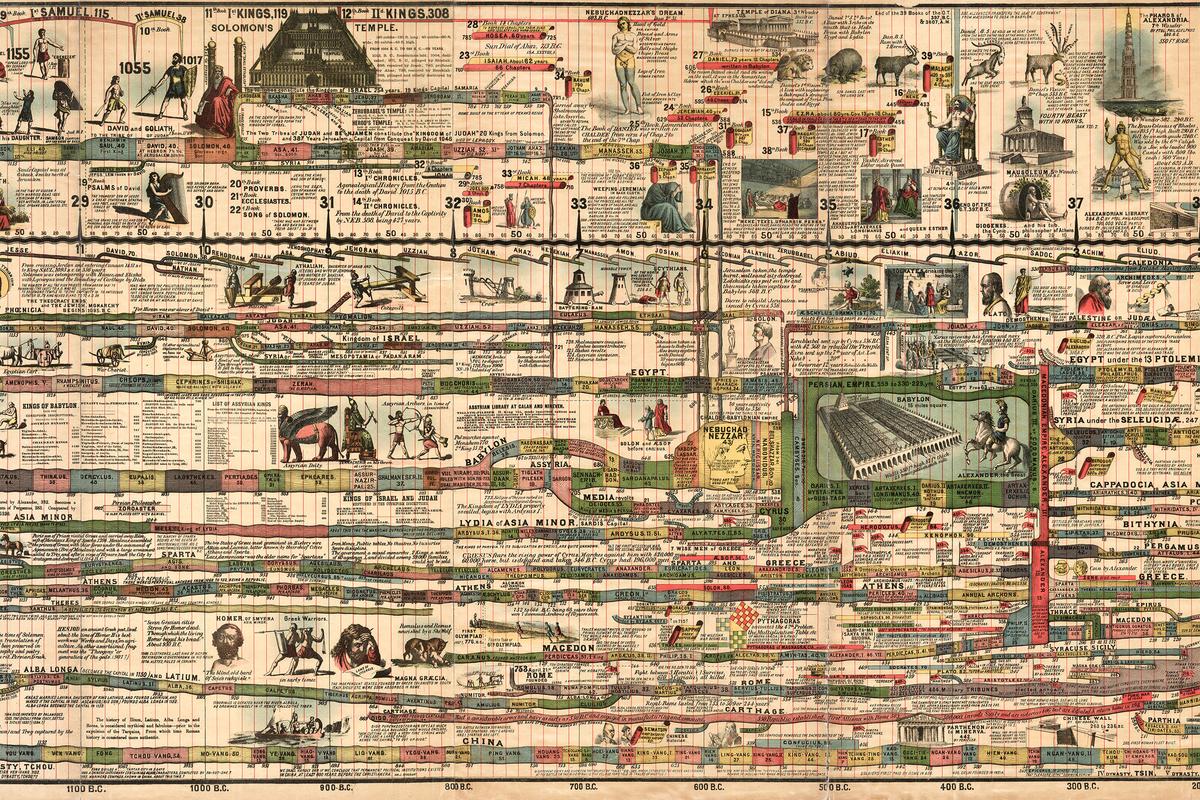
"'It's natural,' says the Stanford Encyclopedia of Philosophy, 'to think that time can be represented by a line.' We imagine the past stretching in a line behind us, the future stretching in an unseen line ahead. We ride an ever-moving arrow - the present. However, this picture of time is not natural. Its roots stretch only to the 18th century, yet this notion has now entrenched itself so deeply in Western thought that it's difficult to imagine time as anything else."
"His creation myth, Timaeus, connected time with the movements of celestial bodies. The god 'brought into being' the sun, moon and other stars, for the 'begetting of time'. They trace circles in the sky, creating days, months, years. The 'wanderings' of other, 'bewilderingly numerous' celestial bodies also make time. When all their wanderings are 'completed together', they achieve 'consummation' in a 'perfect year'. At the end of this 'Great Year', all the heavenly bodies will have completed their cycles, returning to where they started."
The linear picture of time became dominant in Western thought only from the 18th century onwards. Ancient Greek thinkers, especially Plato, tied time to celestial movements, describing a 'begetting of time' as the sun, moon and stars trace circles that create days, months and years. The Great Year idea envisioned all heavenly bodies completing cycles and returning to their starting positions, completing millennia-long universal cycles. Stoic doctrine held an eternal recurrence in which the universe cycles and restarts through conflagration. Cyclical conceptions of time reflect natural rhythms—day and night, seasons—and appear implicitly in biblical writings such as Ecclesiastes.
Read at Aeon
Unable to calculate read time
Collection
[
|
...
]