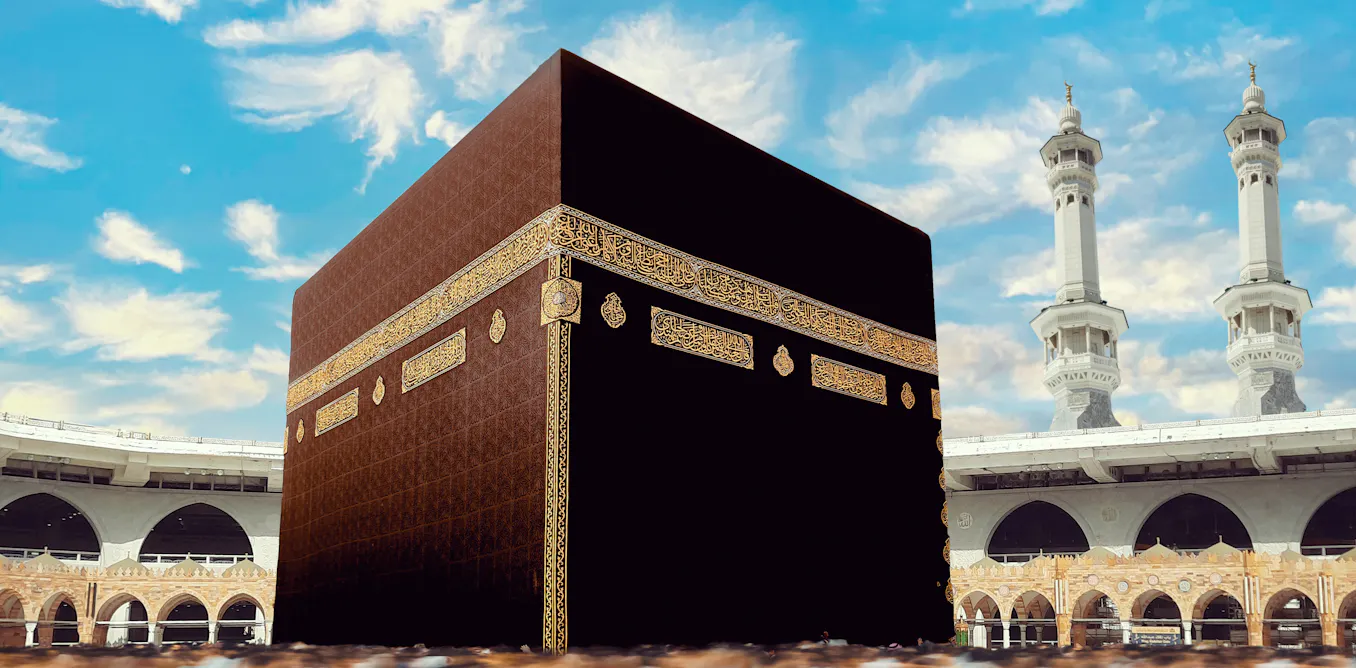
Muslims performing Hajj in Mecca circle the Kaaba seven times in tawāf, with the kiswah as the central visible sacred object. The Kaaba is a roughly cubic gray granite structure about 43 feet tall, believed to have been established by Abraham and Ishmael as a monotheistic worship site. The Kaaba is empty inside, with no altar, idol, or relic displayed, yet it functions as the geographical and spiritual center of Islam. Muslims face the Kaaba during five daily prayers, and the kiswah is what they see when they arrive. Early records describe coverings in striped red wool, and later practices involved replacing accumulated layers to prevent structural collapse. An Abbasid caliph ordered annual replacement with a single cloth, a cycle that has continued for nearly 1300 years.
"As Muslims gather for the annual pilgrimage of Hajj in Mecca, Saudi Arabia, they will circle around the "Kaaba," a black cube draped in gold-embroidered cloth. A ceremonial textile - known as the "kiswah" - covers the Kaaba, around which Muslims will walk seven times in a ritual known as "tawāf." It is the central act of the annual pilgrimage."
"The Kaaba itself is a roughly cubic gray granite structure about 43 feet tall, which Muslims believe was established by the Prophet Abraham - Ibrahim in Arabic - and his son Ishmael as a place of monotheistic worship in antiquity. The Kaaba is empty inside, with no altar, idol or relic on display. Yet, it is the geographical and spiritual center of the Muslim world. Muslims across the globe turn toward the Kaaba during their five daily prayers. The kiswah is what they actually see when they get there."
"The earliest documented covering, recorded in ninth-century Arabic chronicles, is attributed to a Yemeni king named As'ad Abū Karib who reigned around 400 C.E. He is said to have draped the shrine in striped red wool. For centuries afterward, successive coverings were laid one on top of another. As a result, by the eighth century, the accumulated weight threatened to collapse the structure."
"Al-Mahdi, an Abbasid caliph, the dynasty which governed from Persia to Spain between the eighth and 13th centuries, performed the pilgrimage in 777 C.E. He ordered everything stripped down and replaced annually with a single cloth. This cycle has governed the practice for nearly 1300 years. The color wasn't black, as it is today. For most of Islamic history the kiswah was white, red, green, yellow or striped."
Read at The Conversation
Unable to calculate read time
Collection
[
|
...
]