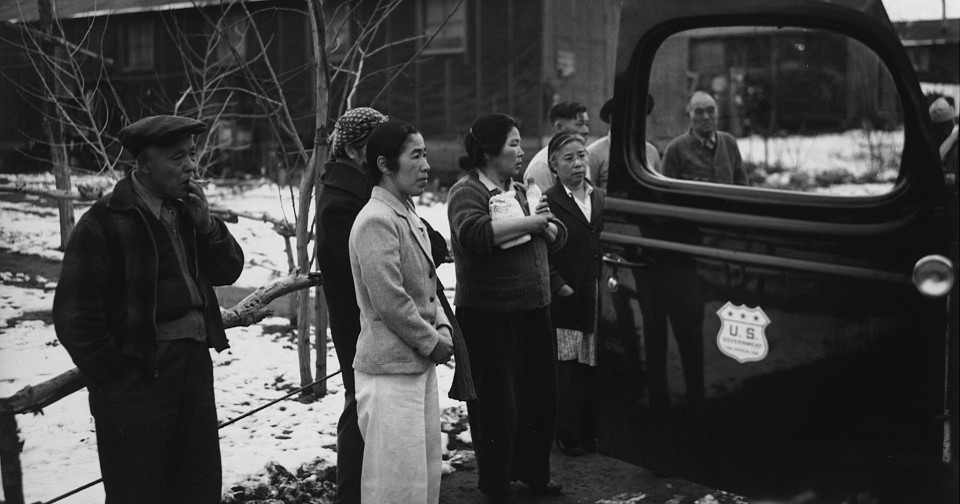
Loyalty has often been misunderstood by the United States government, sometimes treated as patriotism or partisan allegiance. Efforts to create loyalty through official observances have not generated widespread public enthusiasm, suggesting loyalty cannot be commanded. Mandating loyalty may be counterproductive because it requires free, genuine commitment. During World War II, the government detained Japanese and Japanese American residents on the West Coast and Hawaii and imprisoned about 120,000 people, including many American citizens. While detained for up to four years, internees were required to answer loyalty questions that asked about serving in combat wherever ordered and swearing unqualified allegiance to the United States. For many, these questions felt like threats rather than expressions of loyalty.
"Loyalty-a virtue elementary schoolers can explain clearly-has long seemed to confuse the United States government. Some administrations have equated it to patriotism, others to partisan allegiance. Some have tried to manufacture it: In 1955, President Dwight Eisenhower declared May 1 to be Loyalty Day, an anti-Communist alternative to the labor movement's May Day that hardly anyone now celebrates. Americans don't throng to International Workers' Day parades either, so the national disinterest in Eisenhower's holiday seems to suggest that loyalty doesn't happen on command."
"During World War II, President Franklin D. Roosevelt's administration made what may well be the nation's most explicit and pernicious attempt to demand loyalty. In 1942, roughly two months after Pearl Harbor, the government began to detain Japanese and Japanese American residents of the West Coast and Hawaii. Eventually, some 120,000 people, two-thirds of whom were American citizens, were imprisoned in large inland camps. During their detainment, which lasted up to four years, internees had to take a survey that, among other things, asked whether they would serve in the Army "on combat duty, wherever ordered" and "swear unqualified allegiance to the United States of America"."
"If Loyalty Day is uninteresting because it's artificial, then this was something far more sinister. For many internees, the so-called loyalty questions seemed like a threat. Questions 27 & 28, the author Karen Tei Yamashita's tenth book, gets its title from those loaded questions. The novel roves through time, space, and literary styles to tell stories of many Japanese immigrants and their descendants in the United States."
Read at The Atlantic
Unable to calculate read time
Collection
[
|
...
]