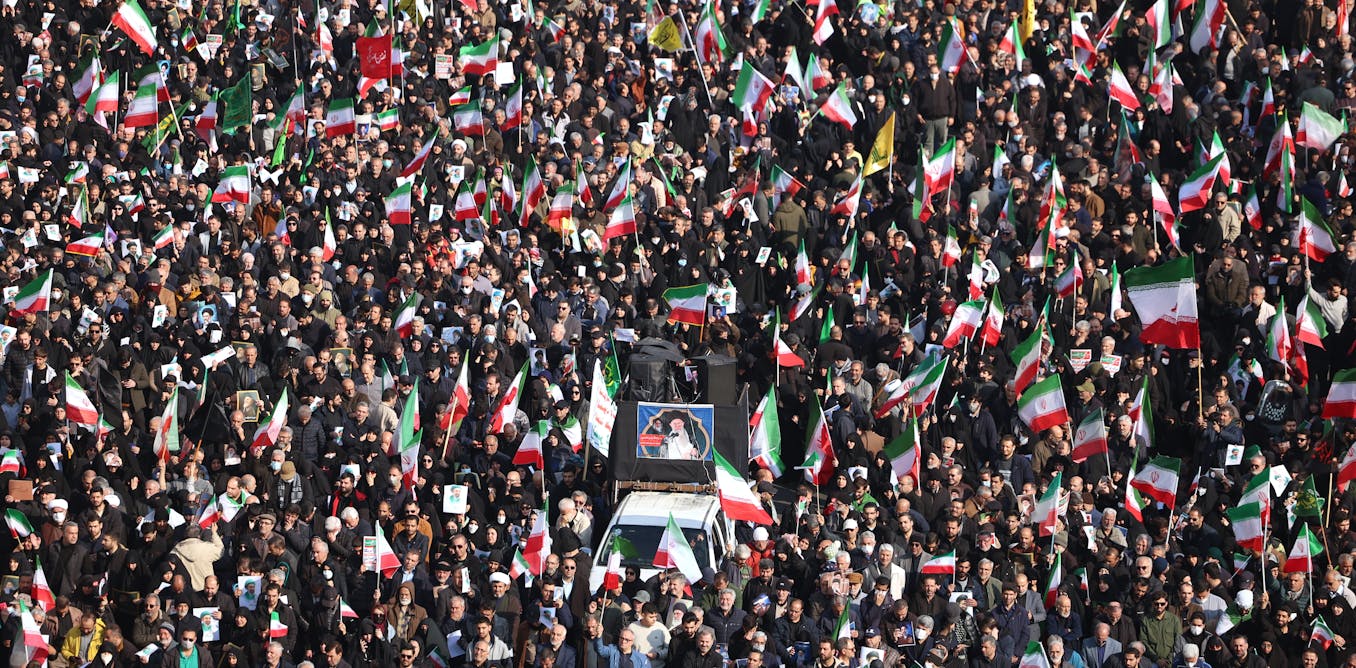
Iran's Islamic Republic operates through multiple interconnected institutions rather than a single authority. The supreme leader position was established after the 1979 Iranian Revolution based on the Twelver Shiite concept of Guardianship of the Jurist, which holds that righteous jurists should administer state affairs until the return of the 12th imam. Originally requiring the supreme leader to be a grand ayatollah, the constitution was amended in 1989 to allow Ayatollah Khamenei to assume the role. The supreme leader serves as lifetime appointment with ultimate religious and political authority, commanding armed forces and supervising state media, though the Assembly of Experts can dismiss them if deemed incapable.
"After the Iranian Revolution of 1979, the position and office of supreme leader was created by the Iranian Constitution. It is based on the concept of the Guardianship of the Jurist, or "Velayat-e Faqih." Under Twelver Shiism - the sect of Shiite Islam that Iranians follow - the concept asserts that state affairs should be administered by righteous jurists, or faqih, until the return of the 12th imam, who is believed to have gone into hiding in 874 C.E."
"Although the supreme leader possesses disproportionate power, he is not the single authority. Instead, he is one of several positions and institutions through which the Islamic Republic's 47-year-old regime organizes its ruling structure."
"Although the supreme leader is a lifetime appointment, Article 111 of the constitution authorizes the Assembly of Experts to dismiss him if he is deemed politically and religiously incapable or unqualified."
#irans-political-structure #supreme-leader-authority #islamic-republic-governance #constitutional-framework
Read at The Conversation
Unable to calculate read time
Collection
[
|
...
]