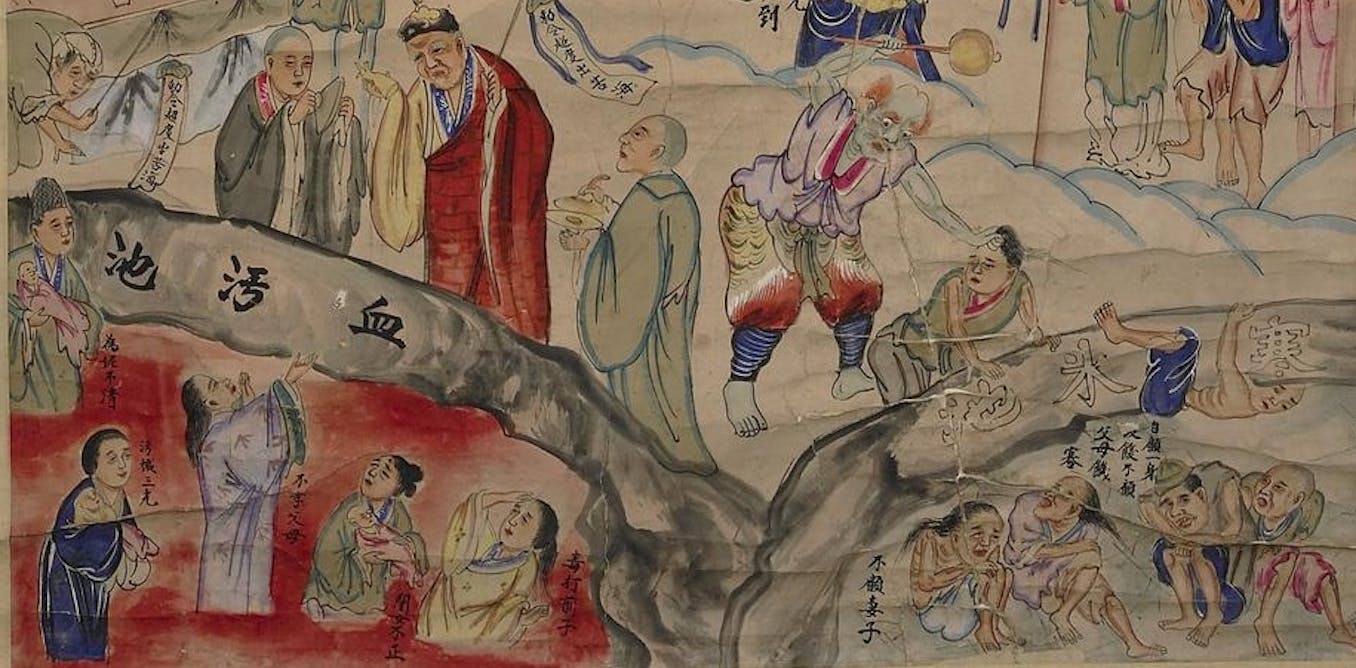
"In many religions and cultures, women who are menstruating or who just gave birth are not allowed to enter sacred sites, such as temples, or participate in religious rituals. This is because they are often seen as ritually impure. Early Christians cited menstruation as the reason for not allowing female deacons or priests. Modern Catholic teachings do not express this attitude directly, but some Catholic feminists argue that views of women's blood pollution still influence the church's position against women's ordination."
"It describes a complicated chain of events in which a woman gives birth at home, then washes her bloody clothes in a nearby river. People downriver don't realize that the water has been polluted with the blood of childbirth, and they use the water to make tea that they offer to the gods. As punishment for offending the gods with tainted water, the woman who gave birth is condemned to fall into the "Blood Pond Hell" after she dies."
Many religions and cultures classify menstruation and postpartum bleeding as ritual impurity, restricting women's participation in sacred places and rituals. Early Christian authorities used menstruation to exclude women from diaconal and priestly roles, and some contemporary Catholic feminists see lingering notions of blood pollution influencing ordination debates. Certain Hindu texts prescribe isolation of menstruating women from household and ritual life, though such taboos are less widely practiced today. A thirteenth-century Chinese Buddhist scripture narrates a tale where childbirth blood pollutes river water, provoking divine offense and condemning the mother to the Blood Pond Hell. Buddhism links such punishments to imbalanced karma affecting rebirth.
Read at The Conversation
Unable to calculate read time
Collection
[
|
...
]