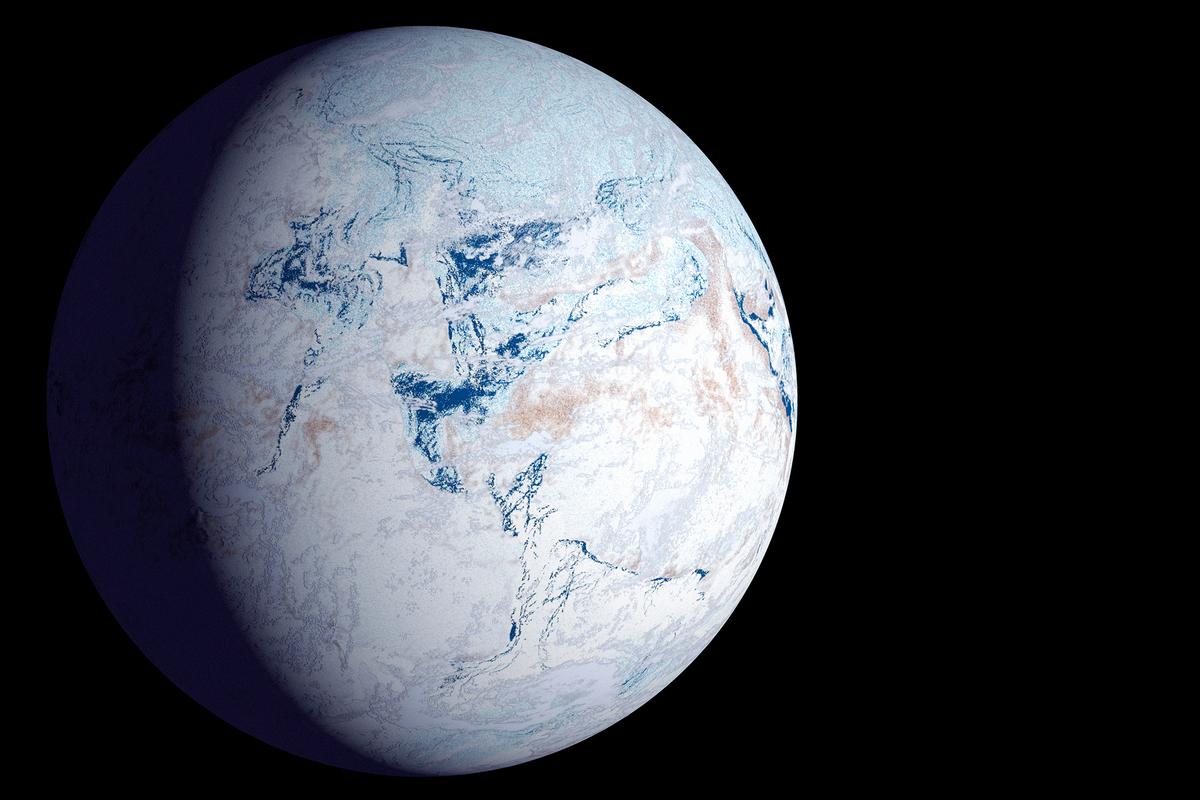
"Such an event, if it transpired on Earth today, would see kilometres-thick ice sheets gouging their way from the Arctic to the Bahamas. Once-diverse ecosystems and climate zones would merge into a single, uniform condition, seemingly destined to be barren. Scientists once argued that such a 'snowball' state could never have existed on Earth since global glaciation could not be reversed. Moreover, on such a world, all life, including our own ancestors, would surely have been extinguished."
"Today's scientists agree that ice did indeed reach the equator on at least two occasions between 717 and 635 million years ago, where it stayed for tens of millions of years. What's more, I and many of my colleagues now think that life not only survived this frozen age, but that such extreme conditions may even have helped life become more complex,"
Remote Garvellach islands preserve rocks that record the abrupt shift from a warm, tropical, photosynthetically rich environment to prolonged global cold. Geological evidence indicates ice reached the equator on at least two occasions between 717 and 635 million years ago, persisting for tens of millions of years. Earlier doubts about the reversibility of global glaciation were overturned by hard evidence. Life survived Snowball Earth conditions, and those extreme conditions may have promoted greater biological complexity that ultimately enabled the evolution of animals. The islands' rocks provide a direct record of that pivotal planetary transition.
Read at Aeon
Unable to calculate read time
Collection
[
|
...
]