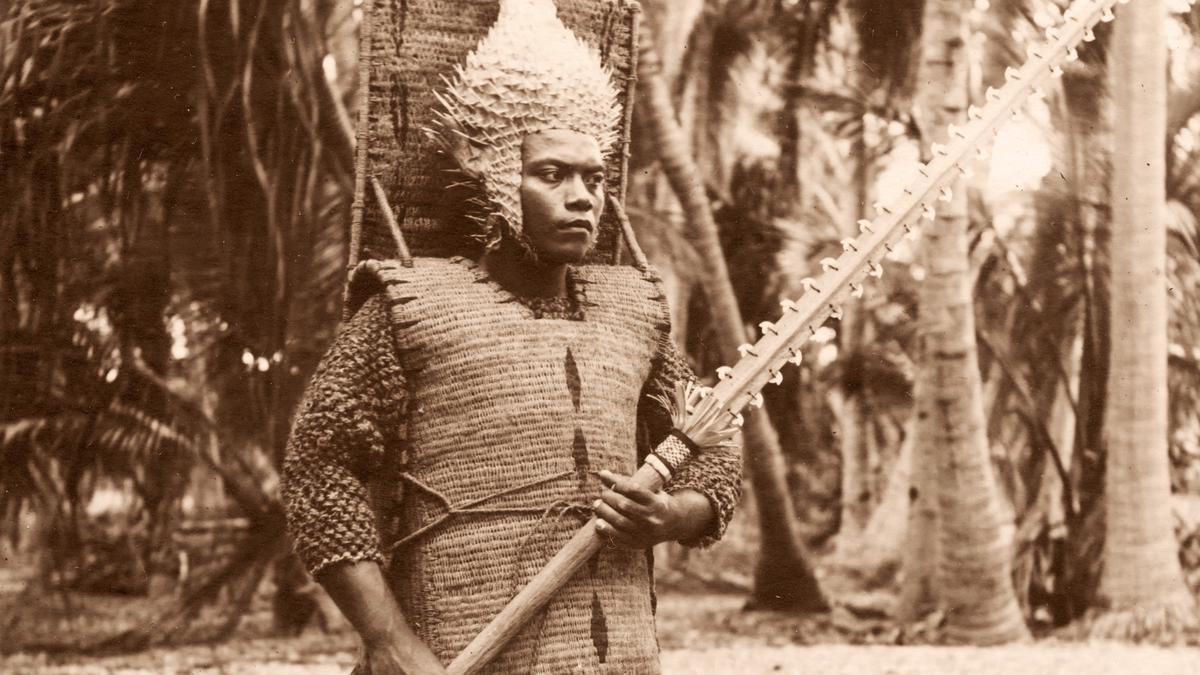
"Visually striking and intricately crafted, the traditional armour and weaponry of the Kiribati islands in the Pacific Ocean were built from coconut fibre, human hair, sharks' teeth and porcupine fish. Yet, fearsome and lethal as these objects were, the people of this remote archipelago weren't especially warlike, as British colonists had long assumed, but were instead part of a ritualised style of combat intended to keep violence between clashing groups to a minimum."
"In this video, Julie Adams, the head curator of the Oceania section at the British Museum, and Kaetaeta Watson, a master I-Kiribati weaver based in New Zealand, discuss both the making and the meaning of these objects. This includes how, after these traditional crafts all but disappeared from Kiribati after the arrival of Christian missionaries in the late 19th century, advocates including Watson are working to preserve them."
Traditional Kiribati armour and weapons were visually striking and intricately made from coconut fibre, human hair, sharks’ teeth and porcupine fish. The objects appear fearsome and lethal but functioned within a ritualized style of combat that minimized violence between groups rather than indicating extensive warfare. British colonial observers misinterpreted the social role of these items as evidence of warlikeness. Many traditional weaving and construction techniques declined after Christian missionaries arrived in the late nineteenth century, causing these crafts to nearly vanish in Kiribati. Contemporary advocates and master I-Kiribati weavers are actively reviving and preserving the making techniques and cultural meanings of these objects.
Read at Aeon
Unable to calculate read time
Collection
[
|
...
]