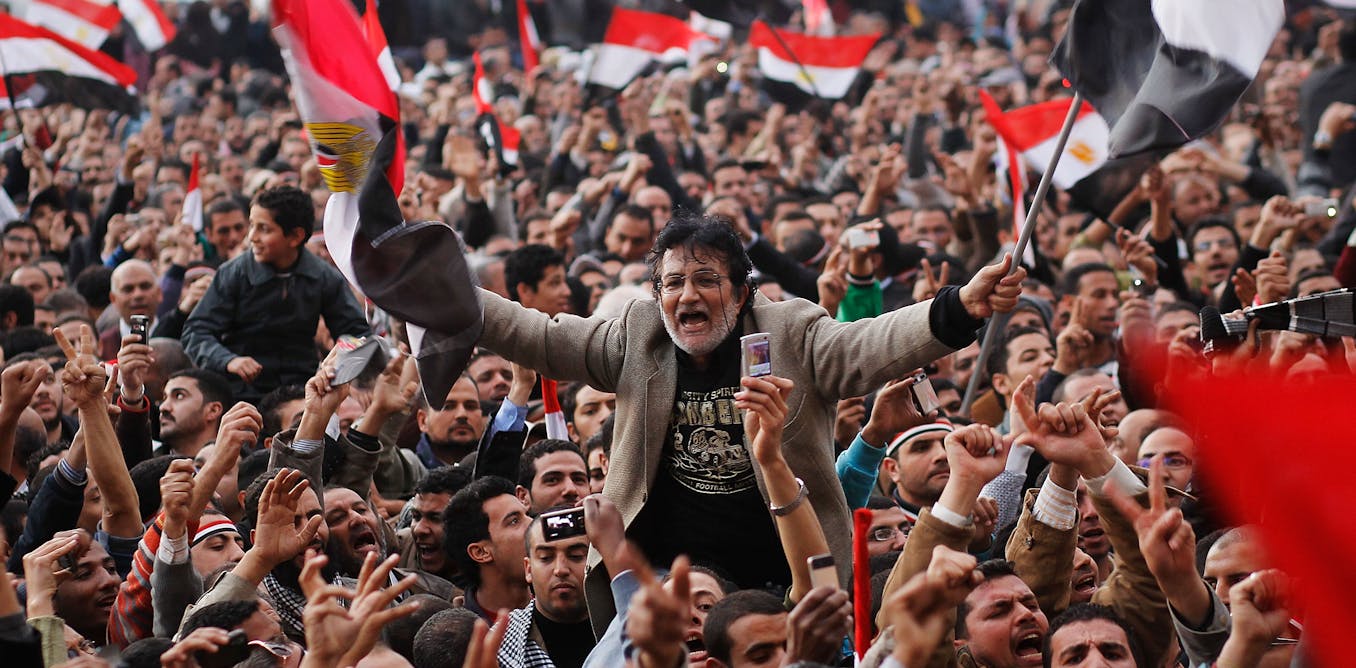
"Fifteen years ago, Egyptians from all walks of life took to the street to demand "bread, freedom, social justice." They were protesting the oppressive 30-year rule of Hosni Mubarak. Egypt had been under martial law for 31 years. This meant that political opposition was silenced, and opponents were often imprisoned and tortured. Police brutality was the norm. Egypt's economy was also weak and relied heavily on foreign aid and loans from the World Bank and International Monetary Fund."
"Neighboring Tunisia had toppled its dictator, Zine El Abidine Ben Ali, on Jan. 14, 2011, after 28 days of protest. The Tunisian revolution's success led to a wave of uprisings against corruption, injustice and economic inequality across the region, including the January 2011 revolution in Egypt. For many who joined the movement in Egypt, there was a newfound sense of unity, equality and nationalism."
For decades Egypt endured authoritarian rule under Hosni Mubarak, with martial law, silenced opposition, imprisonments, torture, and routine police brutality. The economy relied on foreign aid and loans, and despite GDP growth, about 25% of people lived in poverty by 2011. Tunisia's successful uprising in January 2011 sparked regional protests, inspiring Egyptians to demand bread, freedom, and social justice. People across age, class, religion, and gender united for 18 days, culminating in Mubarak's resignation on Feb. 11, 2011. Initial hopes for democratic change were followed by political divisions and disappointments during the fragile transition. Islam is deeply present in daily life, audible in the five daily calls to prayer that punctuate public and private spaces.
Read at The Conversation
Unable to calculate read time
Collection
[
|
...
]