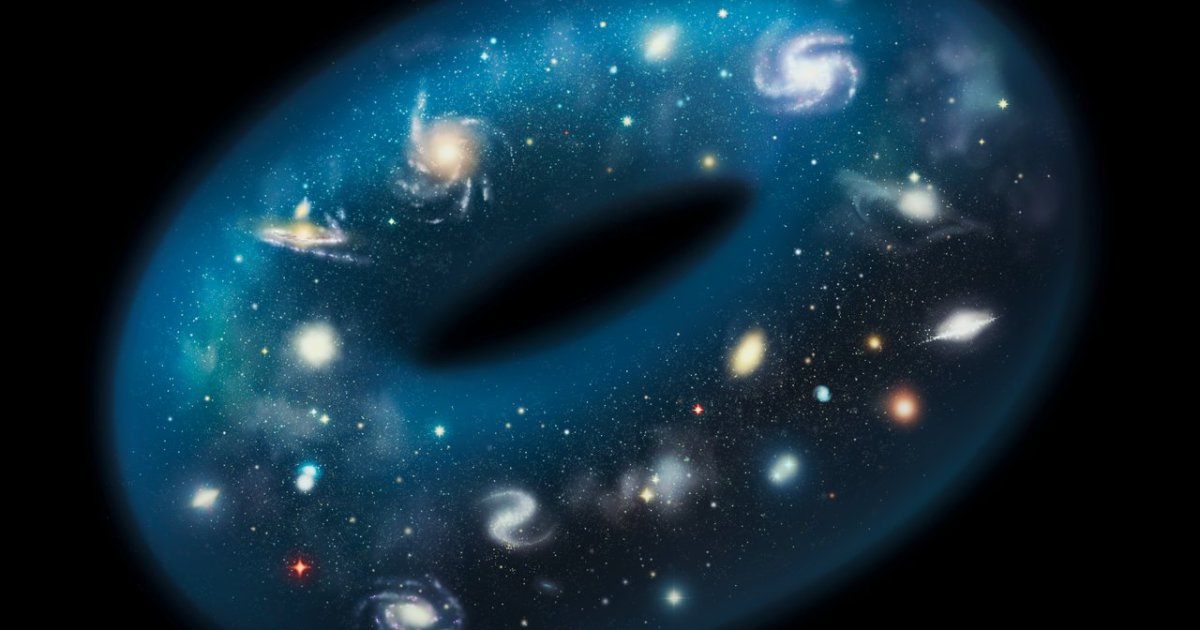
Understanding the Universe's shape represents a fundamental shift from pre-1800s Euclidean geometry and Newtonian physics. Historical perspectives assumed absolute, three-dimensional space with straight-line forces between objects. Modern physics reveals that space itself curves due to matter and energy presence, measurable through direct observation. Despite theoretical preferences for a higher-dimensional spherical universe that expands, reaches maximum size, and recolllapses, empirical evidence indicates the Universe is spatially flat. The Big Bang theory gained scientific consensus following cosmic microwave background discovery and measurement. This flat geometry differs fundamentally from simple three-dimensional grids, representing sophisticated understanding of spacetime structure.
"Like everyone else, you would have learned geometry starting from the rules of Euclid, where space can be no more complicated than a three-dimensional grid. After starting with that notion of absolute space, you would have applied Newton's laws of physics, presuming (like everyone else) that the forces between any two objects would act along the one and only straight line connecting them."
"But we've come a long way in our understanding since then, and not only can space itself be curved by the presence of matter and energy, but we can witness and measure those effects directly."
"But there's a reason we go out and measure the Universe instead of sticking to our theoretical prejudices: because science is always experimental and observational, and we have no right to tell the Universe how it ought to be. Only with the confirmation of the Big Bang, through the discovery and measurement of the cosmic microwave background, did it become the scientific consensus."
#universe-geometry #cosmic-microwave-background #big-bang-theory #spacetime-curvature #observational-cosmology
Read at Big Think
Unable to calculate read time
Collection
[
|
...
]