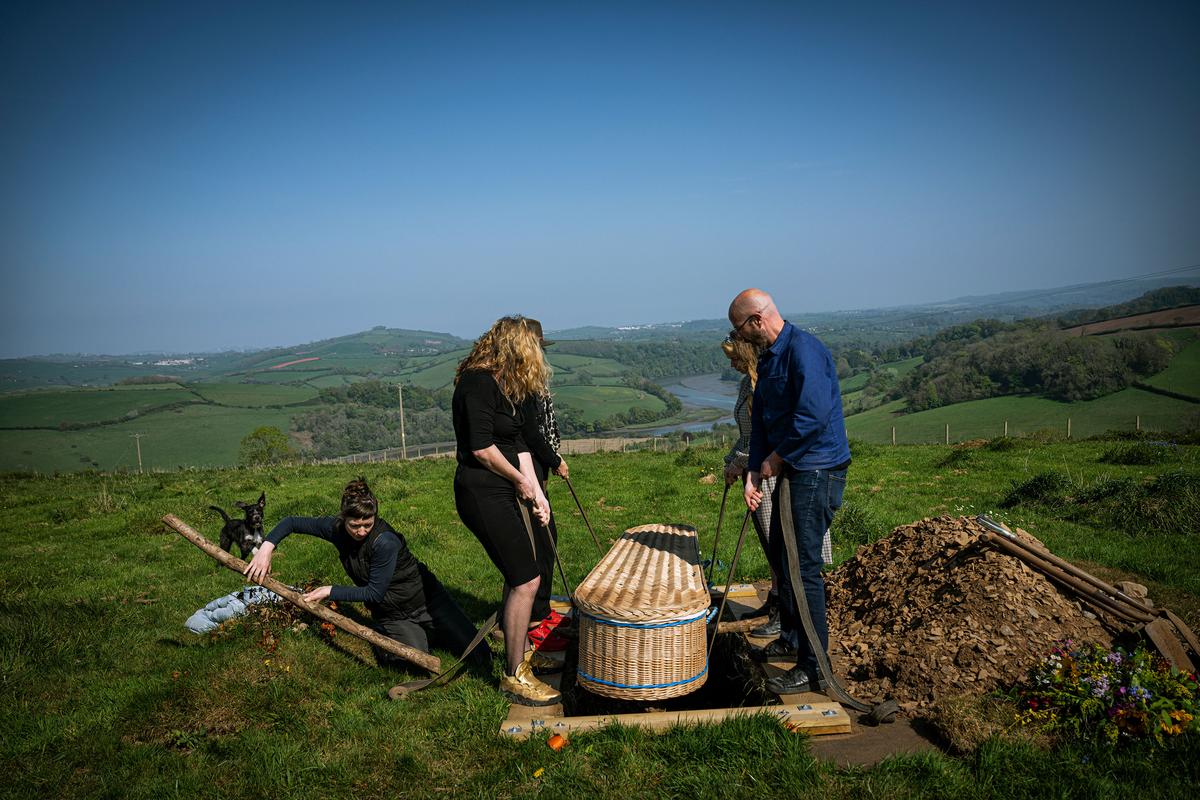
"Each year, roughly 3.6 billion kg of human flesh and bone must be disposed of worldwide, and it is becoming clear that the dominant methods we rely on for that task - burial and cremation - significantly impact the Earth. For example, the emission of nitrogen oxides during a single cremation is roughly equivalent to driving a car almost 3,670 km. Human death and human remains - not only human life and livelihoods - may now be contributing to planetary decline,"
"These conditions have given rise to what Tony Walter, emeritus professor of death studies at the University of Bath in the UK, calls 'a (new) death mentalité'. That is, a new shared attitude in which our attention has shifted from the loss of individuals or communities to 'species extinctions on a scale hitherto unknown during homo sapiens ' time on Earth.' The problem of death seems to demand different answers - new methods."
Human mortality has long shaped cultural practices and symbols, including mortuary rites and tombs as focal cultural signs. Modern disposal methods produce substantial material — roughly 3.6 billion kg of human remains annually — and common practices like burial and cremation generate significant environmental harms, including high nitrogen-oxide emissions per cremation. Growing awareness of these impacts and broader concerns about species extinction have produced a new collective orientation toward death and its ecological consequences. New disposal options aim to reduce environmental harm by transforming remains into trees, soil, or microbial biomass under labels such as 'green death.'
Read at Aeon
Unable to calculate read time
Collection
[
|
...
]