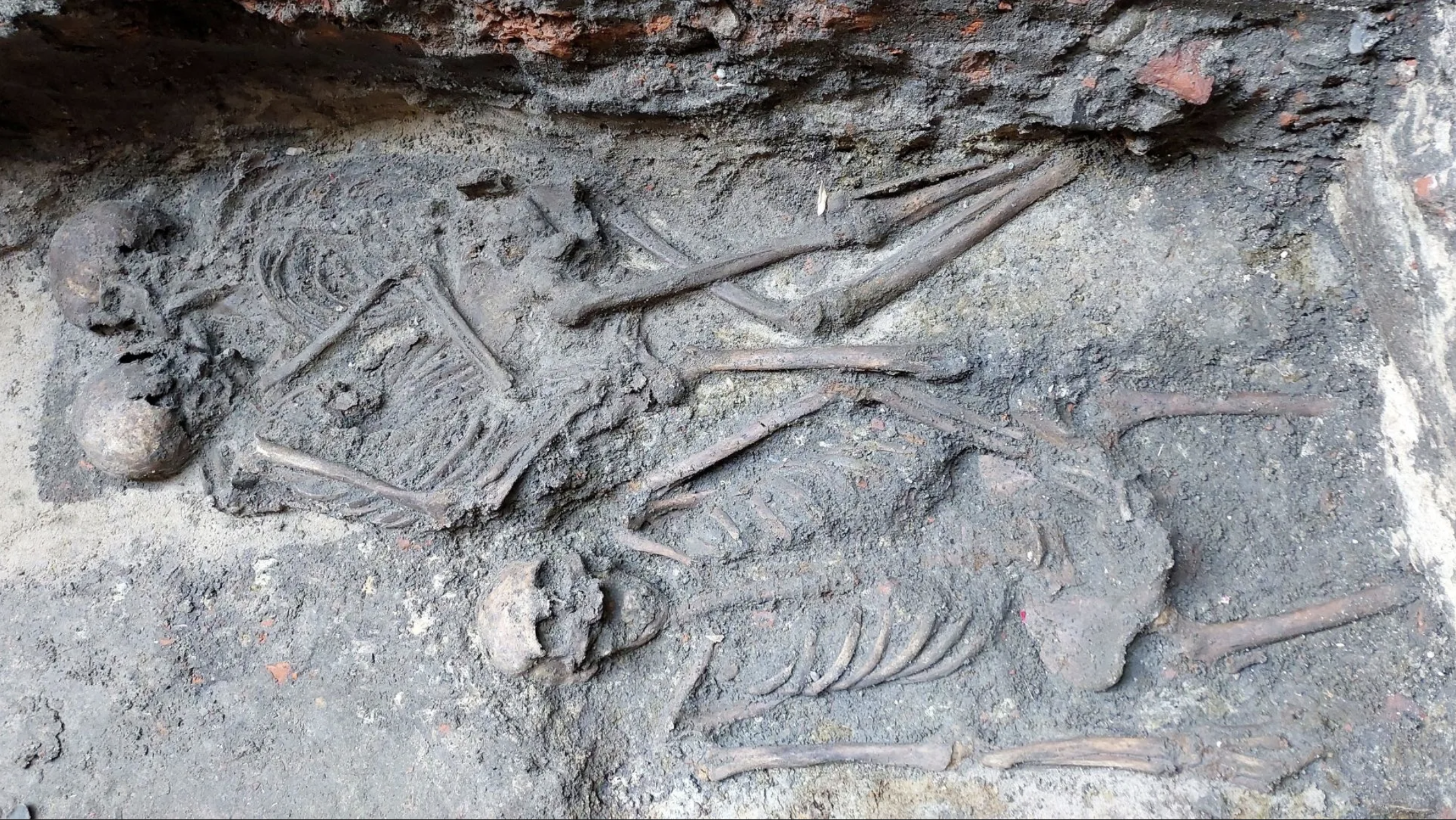
Modern observers often infer relationships from skeletons found embracing, treating the gesture as a strong hint of love or social connection. Archaeology commonly interprets double and multiple burials as evidence of ties such as family or couples, including mother-and-child or adult partners. Assumptions can be overturned when biological evidence is extracted. In Pompeii plaster casts, ancient DNA showed that an adult with a golden bracelet and a child on their lap was an unrelated adult male, not a mother and child. Another embrace pair previously thought to be sisters or lovers included two unrelated individuals, with the smaller person identified as a man. Similar DNA-based questions arise from a new analysis of a double burial in Poland.
"There comes a time in every skeleton's death when, upon their being discovered in a grave hugging another skeleton, modern people start foaming at the mouth guessing at what that relationship might have been. This is understandable and quite defensible from my perspective as a modern person. An embrace is a gesture that transcends however many centuries might separate us. Of course we might wonder who these two people were to each other. We might want to know the nature of their love."
"An embrace is not proof of love, but it is a powerful suggestion of it. In archaeology, people buried in double and multiple burials are often interpreted as having some kind of connection, whether through social or family ties. An adult buried with a child might be interpreted to be the grave of a mother and a son, for example, and a double burial of two adults, male and female, is often interpreted to be a couple."
"In 2024, a paper that extracted ancient DNA from the skeletal material in Pompeii's plaster casts challenged several traditional interpretations. For example, the casts of an adult with a golden bracelet and a child sitting on their lap, traditionally assumed to be a mother and child, were revealed to belong to an adult male who was not related to the child. And the smaller of two people who died in an embrace, traditionally interpreted as sisters or lovers, was revealed to be a man who was unrelated to the other skeleton."
"A new DNA analysis of a double burial in Poland in the Journal of Archaeological Science: Reports raises similar questions about what we can know from the embrace of the long dead. Several years ago, archaeologists excavating the Cathedral of the Exaltation of the Holy Cross, in Opole, found a 13th-century church within the cathed"
Read at Defector
Unable to calculate read time
Collection
[
|
...
]