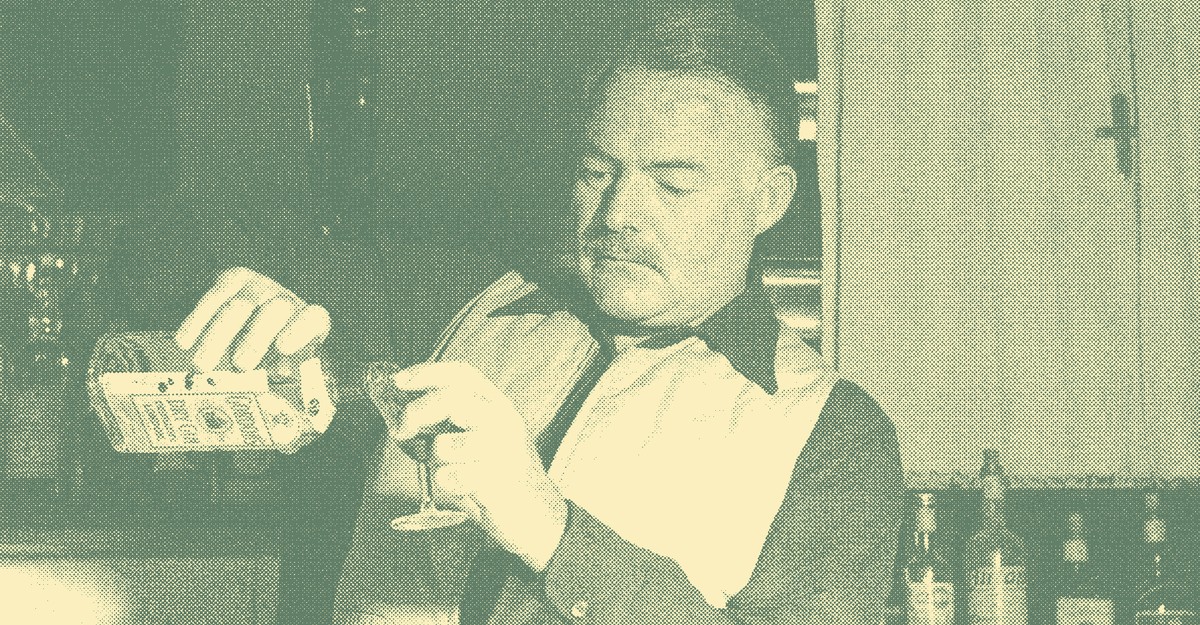
"In 1973, a celebrated writer reportedly knocked on a new colleague's door and held out a glass. "Pardon me," he said by way of introduction. "I'm John Cheever. Could I borrow some scotch?" Raymond Carver did not share Cheever's authorial renown at that time-that would come later. And he did not have scotch. He had only Smirnoff."
"In her 2013 book about writers and drinking, the British critic Olivia Laing describes how Cheever and Carver would drive to a nearby liquor store, stock up, and take alternating swigs of a bottle on their way to teach morning classes at the prestigious Iowa Writers' Workshop."
"Stories about the use of excessive alcohol in the creative process can be found in The Atlantic's earliest years. In 1868, for example, one article proposed that "artists, writers, and actors" were particularly prone to the "malady" of alcoholism "before they had any recognized place in the world." Another noted that third-century sages in China would retreat to the countryside to "drink wine and compose verse." Even before developing writing, our Neolithic ancestors appear to have used alcohol in search of mind-expanding inspiration."
"Sometime around Prohibition and the Roaring '20s, "America developed its distinctive 80-proof version of the romantic myth of the artist," Phyllis Rose wrote for this magazine in 1989. She chronicled Ernest Hemingway, Eugene O'Neill, and William Faulkner, to name a few prominent examples, all of whom embodied the belief that great writing and drinking go hand in hand. Add Sinclair Lewis and John Steinbeck to the list, and you get five of the eight U.S.-born Nobel laureates for literature of the 1900s who had a history of drinking to exc"
In 1973, John Cheever introduced himself to Raymond Carver and asked to borrow scotch, while Carver reportedly had only Smirnoff. A later account describes Cheever and Carver buying liquor and taking alternating swigs on the way to teach at the Iowa Writers’ Workshop. Stories connecting alcohol and creativity appear across earlier eras, including claims that artists and writers were prone to alcoholism and references to Chinese sages who drank wine and composed verse. The romantic myth of the artist with alcohol became especially prominent in the Prohibition and Roaring ’20s period, with writers such as Hemingway, O’Neill, Faulkner, Sinclair Lewis, and John Steinbeck often cited as examples.
#alcohol-and-creativity #literary-culture #iowa-writers-workshop #prohibition-era #romantic-myth-of-the-artist
Read at The Atlantic
Unable to calculate read time
Collection
[
|
...
]