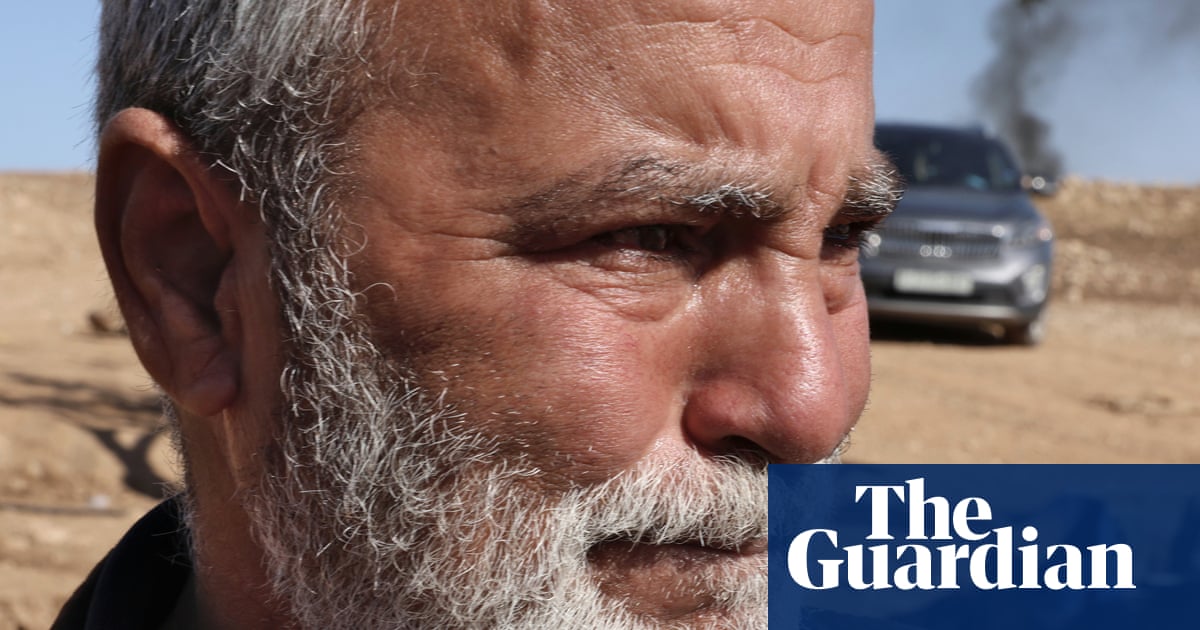
"Five decades in the south Jordan valley were ending in a day, and Mahmoud Eshaq struggled to hold back his tears. The 55-year-old had not cried since he was a boy, but as he dismantled the family home and prepared to flee the village where his whole life had played out, he was overwhelmed by grief. While Eshaq's children loaded mattresses, a fridge, sacks of flour and suitcases of clothes into a truck,"
"The ethnic cleansing of Ras Ein al Auja was underway, and the men and boys who made life untenable for Palestinians here had come to celebrate. The Israeli settler shepherd, escorted by a white truck with Israeli soldiers. Photograph: Quique Kierszenbaum/The Guardian Eshaq's home, a community of about 135 families, was the largest and most established of the Bedouin villages dotted on hillsides in this part of the Jordan valley. By the start of this year, it was also the only one left."
Mahmoud Eshaq dismantled his family home and fled Ras Ein al Auja, overwhelmed by grief after five decades in the South Jordan Valley. Masked soldiers and celebrating settlers paraded through the village as families loaded possessions into trucks. Settler violence — including arson, mass theft, beatings, intimidation and property destruction — forced out neighboring Bedouin villages until only a few remained. Settlers now control more than 250 sq km of land in this part of the occupied West Bank that the international community earmarked for a future Palestinian state. Villagers describe peaceful lives turned untenable by sustained settler aggression.
Read at www.theguardian.com
Unable to calculate read time
Collection
[
|
...
]