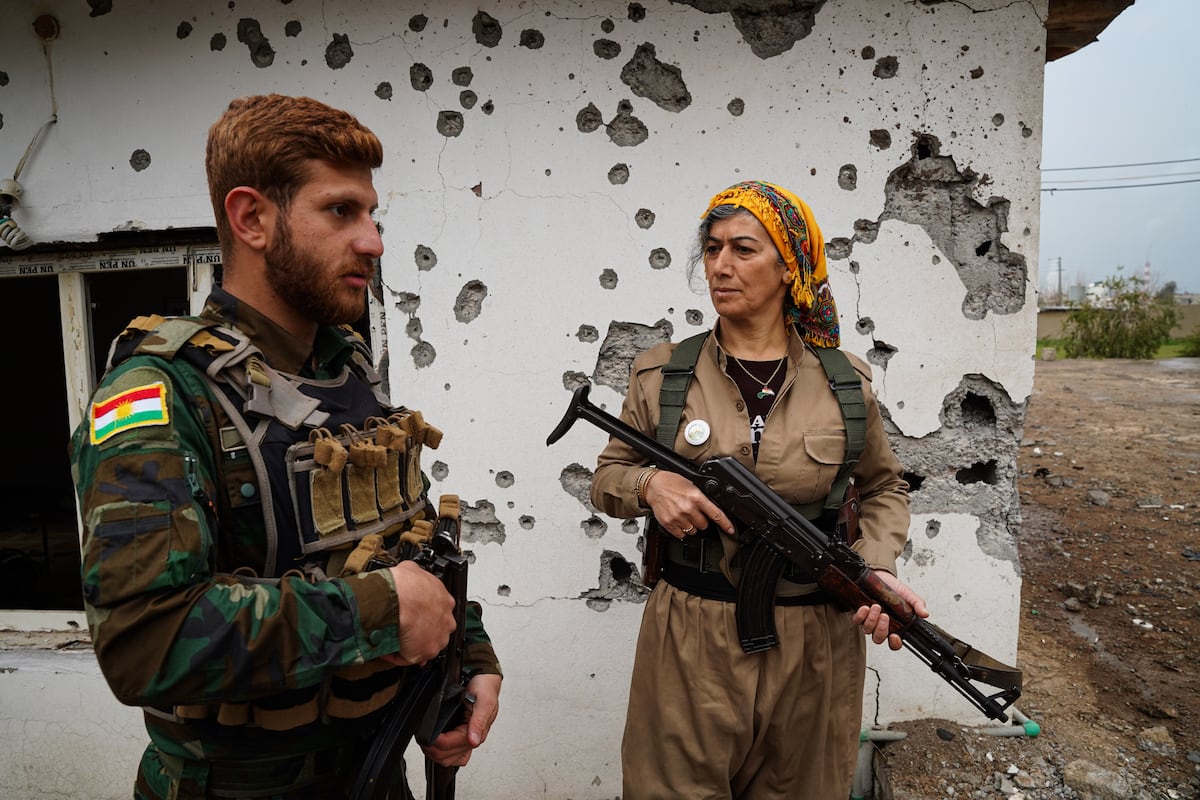
"Whenever the central government in Tehran is weak, centrifugal forces emerge among ethnic and religious minorities in the outlying regions, often with external support. This happened after World War I and World War II and after the 1979 Revolution, argues Iranian political scientist Ali Alfoneh of the Arab Gulf States Institute."
"Established in northwestern Iran in 1946, with its capital in Mahabad, it was one of several attempts to create an independent state for the Kurds—considered one of the world's largest stateless peoples—but, like the others, it failed spectacularly: it lasted just 10 months, when the Soviet troops that had been protecting it withdrew."
"The legacy of Mahabad, however, lives on among Kurdish nationalism: two grandsons of one of its military leaders, Mustafa Barzani, hold the positions of prime minister and president of Iraqi Kurdistan, an autonomous region established with U.S. support as a reward for its role in the overthrow of Saddam Hussein's regime in 2003."
The Trump administration's strategy regarding Iranian Kurdish militias remains inconsistent, with plans to use them against Iran being shelved despite earlier leaks suggesting their involvement. Iranian Kurdish groups express readiness to act against the Islamic Republic during moments of regime weakness. The historical Republic of Mahabad, established in northwestern Iran in 1946 with Soviet protection, lasted only ten months before collapsing when Soviet forces withdrew. This historical precedent serves as both inspiration and cautionary tale for contemporary Kurdish nationalism. Ethnic and religious minorities in Iran's outlying regions have historically mobilized during periods of central government weakness, often with external support. Kurdish leadership legacies persist through figures like Barzani's descendants in Iraqi Kurdistan, and through organizations like the Democratic Party of Iranian Kurdistan, which continues from Mahabad's era.
Read at english.elpais.com
Unable to calculate read time
Collection
[
|
...
]