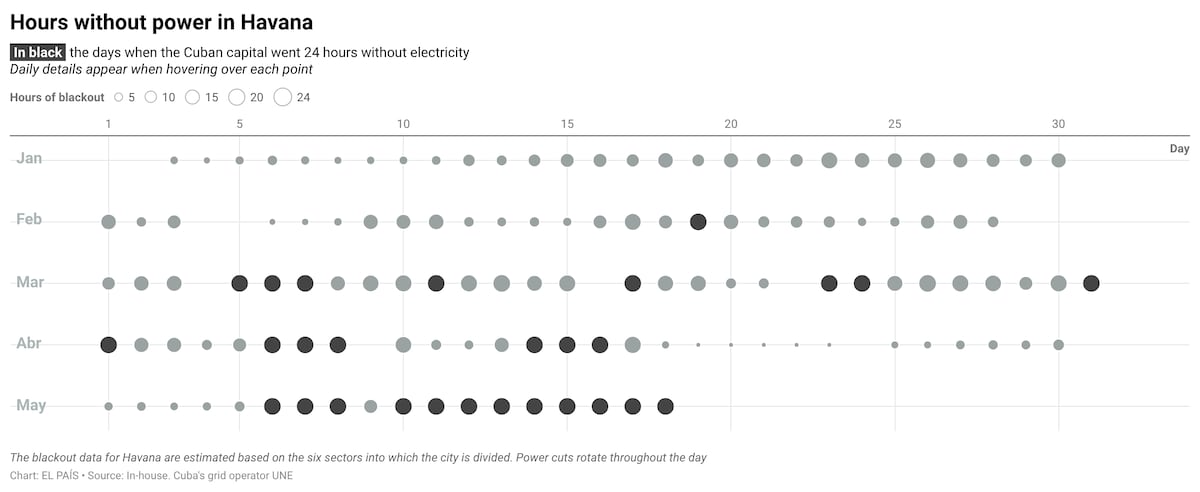
Cuba’s electricity shortages have become so severe that people focus on brief moments when lights return rather than on blackouts. The island now experiences about 22 hours a day without electricity, and blackouts have sometimes lasted 24 hours. The National Electric System has suffered multiple failures, including two in March and a partial disconnection that left about two-thirds of the country without power. Oil and fuel supply shortfalls have contributed, including limited impact from a Mexican shipment that covered only a day of Cuba’s deficit. Venezuela’s oil deliveries have dropped sharply over recent years, reducing the historical support Cuba relied on from major patrons such as the Soviet Union, Venezuela, and Mexico.
"Humor is often the Cuban people's best tool for capturing their reality. That's why, on an island that now spends more hours in darkness than with electricity, people no longer talk about apagones (blackouts) but about alumbrones fleeting moments when the lights actually come on. The reason you are forced to survive 22 hours a day without electricity is not due to an oil blockade by the U.S."
"Cuba's energy crisis is chronic, but the U.S. pressure campaign announced at the end of January has pushed an already fragile system to the brink. An analysis of the Cuban government's 2026 figures carried out by EL PAIS shows that Cuba's power supply is in an unprecedented state. There have been several days when blackouts lasted 24 hours. In the past 18 months, the National Electric System (SEN) has suffered seven failures."
"But in March alone, there were two, plus a partial disconnection that left two-thirds of the country without power. Barely two months had passed since the Ocean Mariner, a ship sent by Mexico, ran aground in Havana. It was the last to arrive before the U.S. threat of sanctions. The impact of that shipment was never felt. The reasons were obvious: the 86,000 barrels barely covered Cuba's oil deficit for a single day."
"Even before Nicolas Maduro was detained in January, Venezuela had significantly reduced oil shipments to the island. At the height of Venezuela's Chavismo movement, the South American country sent more than 100,000 barrels a day. By 2025, that figure had fallen to around 30,000, according to independent estimates. Historically, Cuba has always depended on a patron to keep its economy afloat. During the Cold War, its support came from the Soviet Union. Later, it was Venezuela and, more recently, Mexico."
Read at english.elpais.com
Unable to calculate read time
Collection
[
|
...
]