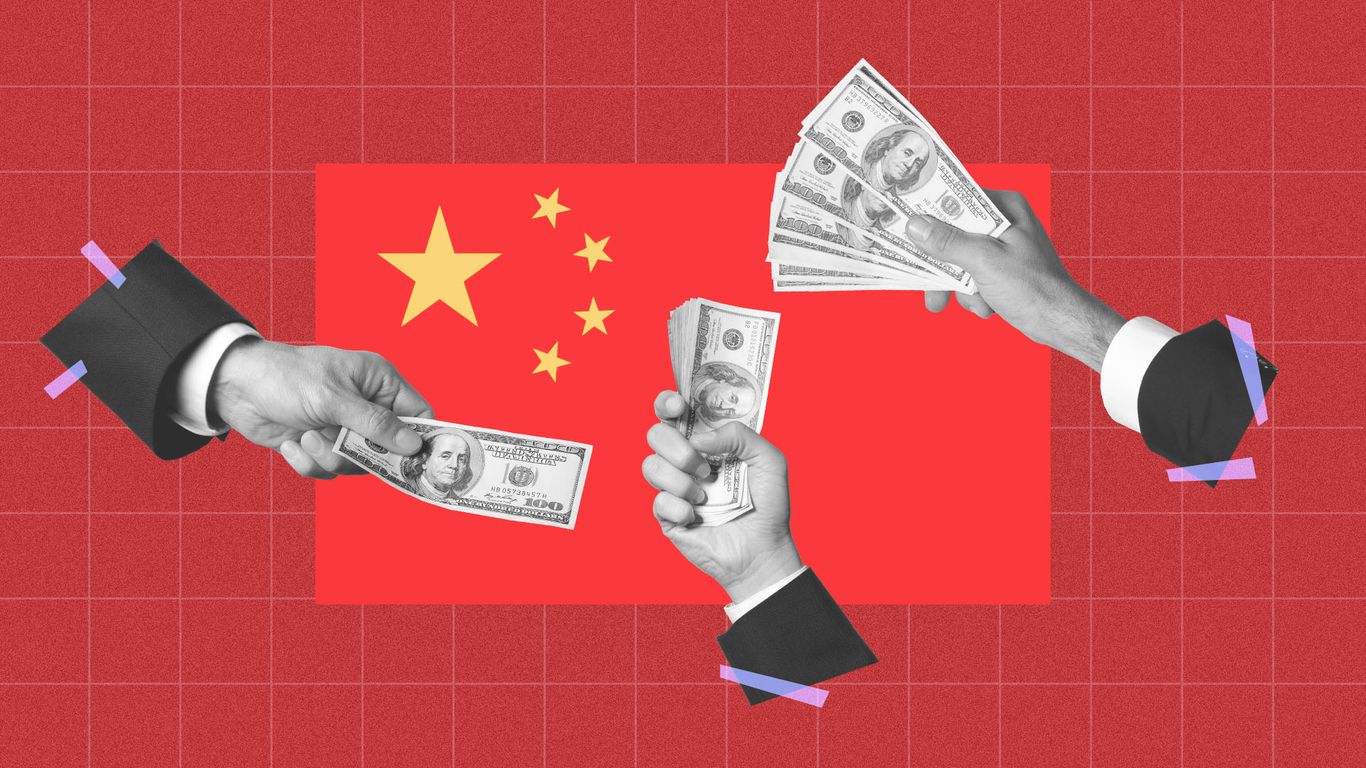
"For China, it would mean relaxing its strict controls on the flow of capital into and out of the country, an important tool of state power - and a contrast to the U.S., where dollars flow more freely. Driving the news: Published remarks by Chinese President Xi Jinping in Qiushi magazine, a leading ideological journal for the Chinese Communist Party, extol the importance of the nation achieving global financial might."
""What constitutes a strong financial nation?" the article says per Bloomberg's translation. "First, it should have a powerful currency, widely used in international trade, investment and foreign exchange markets, holding the status of a global reserve currency." Zoom out: The dollar is used worldwide in trade - even when neither party to the transaction is American - and by global investors seeking a safe place to park money."
"Yes, but: If China wants to replicate that power and take U.S. primacy down a peg or two, a magazine essay alone won't cut it. Dollar dominance is powered by a complex network of interconnected factors. There's the availability of trillions in U.S. Treasury debt that can be freely bought and sold around the world, an independent central bank, a currency that floats based on market conditions, and complex payment systems built over decades."
China seeks global financial might by internationalizing its currency and relaxing strict capital controls, contrasting with the U.S. where dollars flow freely. Dollar dominance gives the U.S. geopolitical leverage because dollars are widely used in trade and by global investors as a safe asset. Reserve status rests on deep, liquid U.S. Treasury markets, an independent central bank, a floating currency, and longstanding payment infrastructure. Replicating that power requires substantial high-quality assets, market depth, institutional credibility, and integrated systems, while alternatives currently lack comparable depth and liquidity.
Read at Axios
Unable to calculate read time
Collection
[
|
...
]