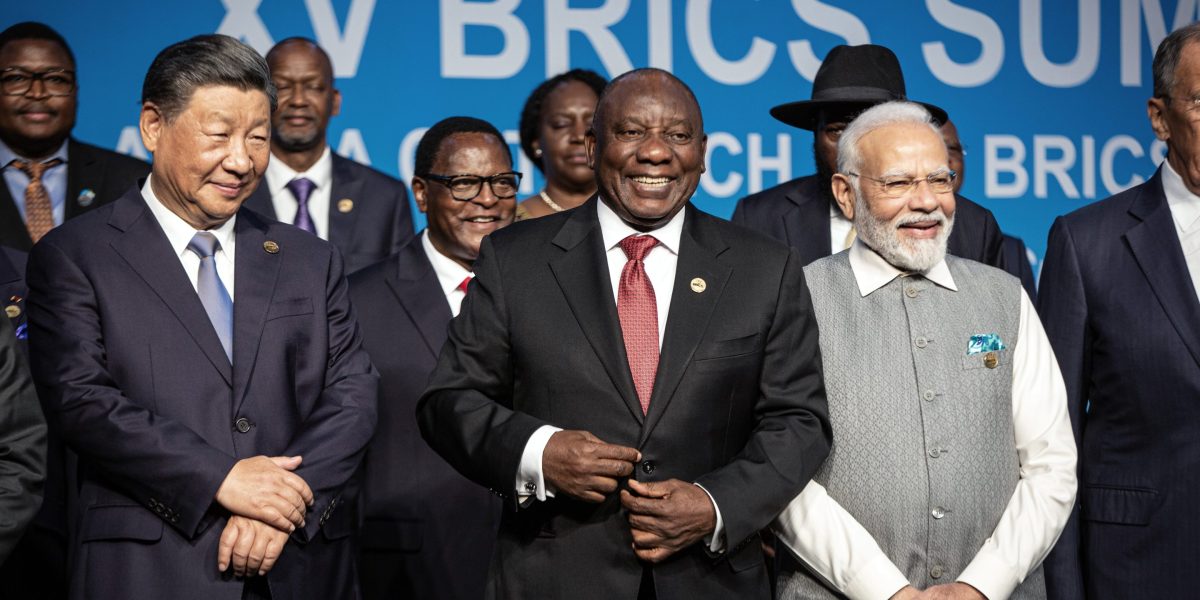
"As of January, it now comprises ten countries: the original five of Brazil, Russia, India, China and South Africa, and five new additions in Egypt, Ethiopia, Indonesia, Iran, and the United Arab Emirates. As the postwar U.S.-led international order shows its cracks, it can be tempting to view BRICS as a potential pillar of a new world order. It has almost half of the world's population, almost three-quarters of its rare earth minerals, and over a third of its crude oil."
"In the eyes of its advocates, BRICS is the core of a new world order, where Western voices can no longer dictate the global agenda or serve as the only source of finance, technology, or expertise. It can serve as an avenue to find new markets, build new supply chains and hedge against a more protectionist White House. BRICS is certainly spooking some in Washington."
BRICS comprises ten countries: Brazil, Russia, India, China, South Africa, Egypt, Ethiopia, Indonesia, Iran, and the United Arab Emirates. The grouping represents almost half of the world's population, nearly three-quarters of rare earth minerals, and over a third of global crude oil. Advocates portray BRICS as a core alternative to Western-led institutions, offering markets, supply-chain options, and financial and technological independence. Washington has reacted with threats of tariffs against BRICS-aligned countries. The primary risk to BRICS stems from internal dynamics: rapid enlargement, potential incohesion, and failure to deliver governance reforms. The bloc requires ground rules, enforcement, a common message, and management of China–India rivalries.
Read at Fortune
Unable to calculate read time
Collection
[
|
...
]