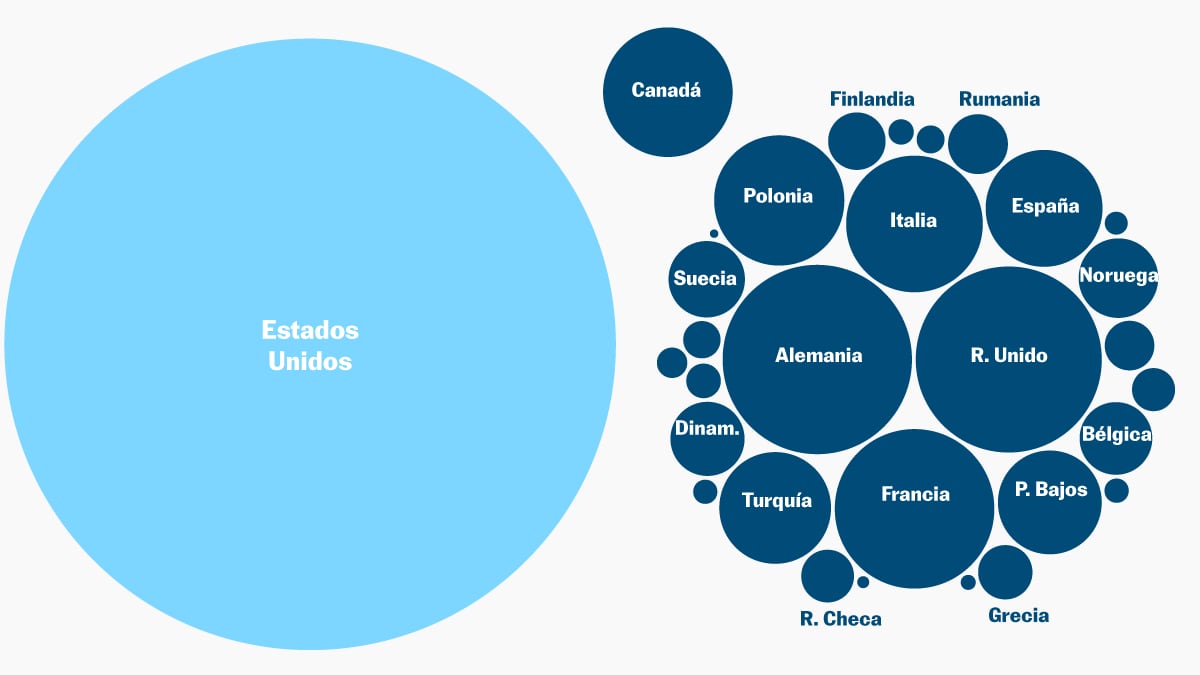
"Donald Trump has presented NATO with an existential dilemma. The U.S. president has long been attacking the military organization. He has even gone so far as to question its very core, its fundamental principle: the mutual defense clause. Now, the White House's threats against Greenland, an autonomous territory that is part of Denmark a NATO member like the United States without ruling out military action, could shatter the transatlantic alliance on which Europe has relied for its security since the end of World War II."
"Danish Prime Minister Mette Frederiksen issued an unusually stark warning: If the U.S. chooses to attack another NATO country militarily, then everything stops, including NATO and thus the security that has been established since the end of the Second World War. But the wound has already been laid bare, and the rest of Europe is being forced to accept that the new order is here to stay."
"The situation is so unusual that the treaties of the organization which stipulate that its members must resolve their disputes peacefully do not address what to do if one ally directly attacks another. Even less so if the aggressor is the most powerful member against one of the smaller ones one that is strong and committed in terms of investment and participation in missions."
"NATO continues to consider Russia its primary threat. However, the greatest danger now appears to lie within its own ranks. Would a U.S. incursion into Greenland truly spell the end of the Alliance? Jamie Shea, a high-ranking NATO official until 2018, is in no doubt. It would constitute a complete repudiation of the principles of the UN Charter, upon which the 1949 NATO Treaty is based."
A U.S. president's repeated attacks on NATO and threats concerning Greenland challenge the alliance's core mutual-defense principle. A U.S. military move against Greenland, an autonomous part of Denmark, risks shattering the transatlantic security framework established after World War II. Denmark's prime minister warned that a U.S. attack on another NATO member would halt the alliance and its security guarantees. NATO treaties do not anticipate an ally directly attacking another, especially when the aggressor is the most powerful member. The crisis coincides with Russia's war in Ukraine and raises the prospect that internal fracture, rather than external threat, is NATO's greatest danger.
Read at english.elpais.com
Unable to calculate read time
Collection
[
|
...
]