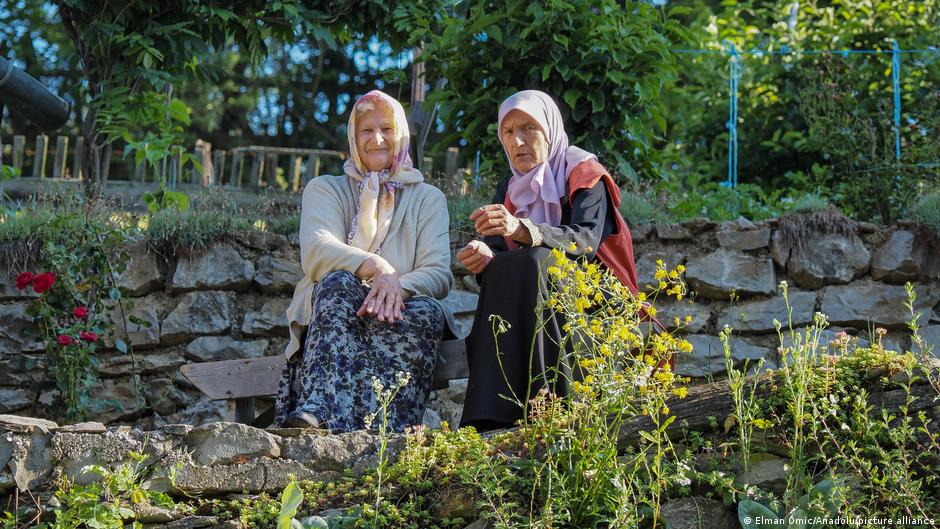
"Usually, it tends to be Muslim men who go to pray on Fridays in the mosques of Bosnia and Herzegovina. As is customary in Islam, women are not required to go to the mosque to pray on the holiest day of the week. However, more and more, devout Muslim women in the Western Balkan country want to attend the mosque, too."
"In the secular state of Bosnia and Herzegovina, men and women are equal before the law. In recent decades, the state has made significant efforts to eliminate gender-based discrimination and protect women from violence. However, in certain religious communities, whether these are Muslim, Orthodox or Catholic, social and cultural norms continue to stand in the way of equality."
""Muslim feminists are fighting for women's rights within an Islamic framework," Bosnian sociologist Dermana Kuric from the University of Sarajevo told DW. She said that they were doing this by taking an active role in society without openly challenging misogynistic interpretations of the Quran. She added that university educated Muslim women were consciously engaging with traditional Islamic scholarship, which has sought to confine women to a subordinate role in the family and the wider community."
""Muslim feminists are concerned with gender relations based on autonomy and individual responsibility as opposed to control or dominance," Kuric said. Dermana Kuric is a sociologist at the University of SarajevoImage: Hasan Hasic Bosniaks part of broader Muslim feminist movement Bosnian Muslim feminists are part of a broader movement that has been gaining influence in the Islamic world since the 1980s."
In Bosnia and Herzegovina, Friday mosque attendance is traditionally dominated by Muslim men, while women are not required to attend for prayer. Increasing numbers of devout Muslim women want to participate in mosque life. The country is secular and provides legal equality between men and women, alongside efforts to reduce gender discrimination and protect women from violence. Despite these protections, conservative social and cultural norms persist in some religious communities, shaping expectations that women should primarily be mothers and caregivers. After the Bosnian War, religion became more prominent across communities, including among Muslim Bosniaks, Orthodox Serbs, and Catholic Croats. Muslim feminists seek women’s rights within an Islamic framework by engaging society and traditional scholarship while emphasizing autonomy and individual responsibility rather than control.
Read at www.dw.com
Unable to calculate read time
Collection
[
|
...
]