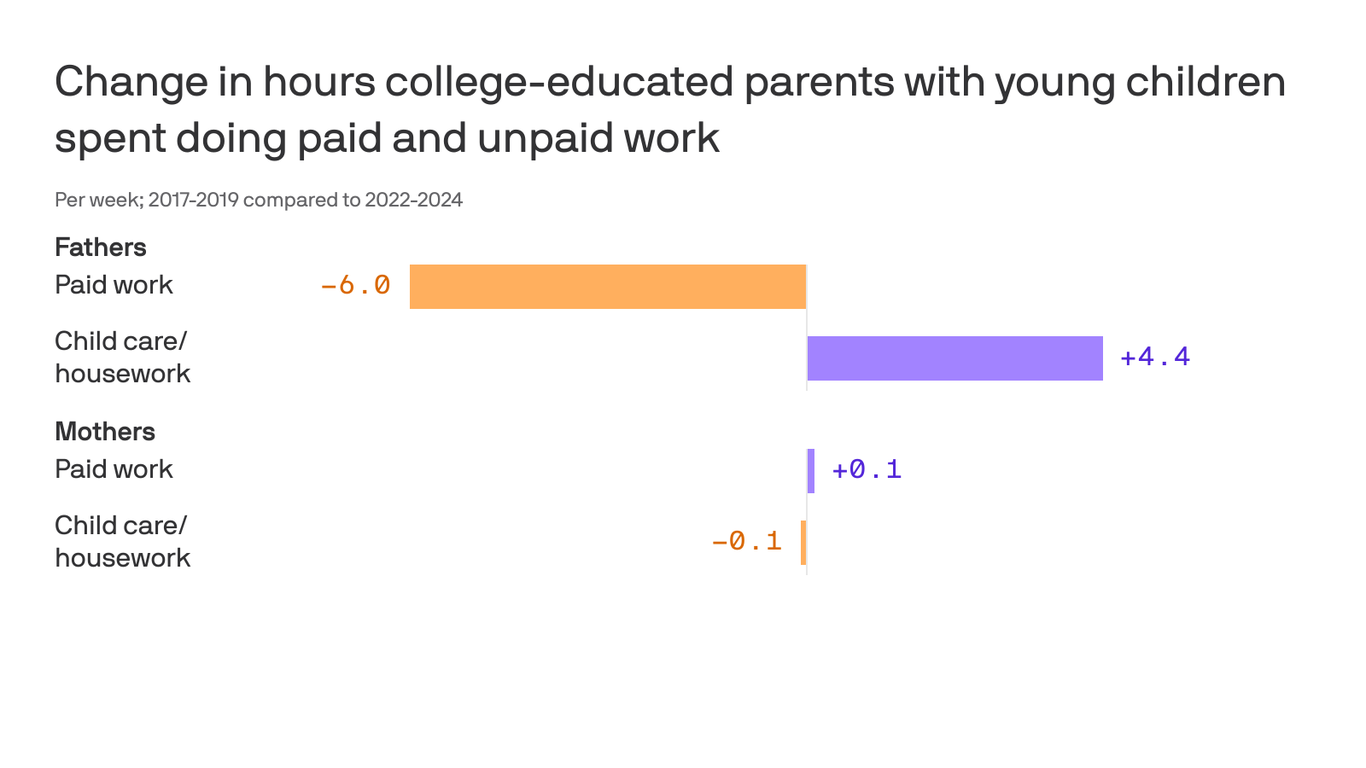
"Binder compared how men and women use their time, using census data from 2017-2019 and from 2022-2024, leaving out the unusual pandemic years. The analysis compared couples and singles, and the pronounced changes showed up in couples rather than among singles. The focus was on time spent on paid work versus unpaid work such as child care and housework, especially for fathers and mothers with young children."
"Since the pre-COVID era, partnered college-educated fathers with young children cut back the time they spend on paid work by six hours a week. Meanwhile, they increased the time spent doing child care and housework by more than four hours. Mothers' hours were basically unchanged. The same changes were observed among non-college-educated men and women, although they were less pronounced, with fathers seeing only a slight decline in paid hours and a nearly three-hour uptick in unpaid work."
"Women still do much more unpaid work. Among couples with at least one young child, women do nearly 15 more hours weekly than men, down from nearly 19 hours in the pre-pandemic period. For decades, women have been increasing their working hours and slightly reducing their time in unpaid work, while men's patterns have been relatively stable. Now, something else is going on, possibly a real cultural shift in expectations for men."
"Women really changed their behavior over the decades leading up to the pandemic, but now this kind of shift in household priority seems to be driven by men. Only part of the explanation is the rise of remote work, but it's also possible that the experience of being home in the pandemic reshuffled fathers' priorities. There is, of course, a backlash. In the wake of the pandemic, dads are getting way more into the dad thing."
Time-use patterns shifted after the pandemic, especially for partnered men. Analysis of census data comparing 2017–2019 with 2022–2024, excluding pandemic years, shows partnered college-educated fathers with young children cut paid work by about six hours per week. They increased time on child care and housework by more than four hours, while mothers’ hours were largely unchanged. Similar directions appeared among non-college-educated couples, with smaller changes. Women still perform far more unpaid work, with women in couples with at least one young child doing nearly 15 more hours weekly than men. Over decades, women increased paid work and slightly reduced unpaid work, but recent household priority shifts appear driven by men, potentially influenced by remote work and pandemic experiences, with backlash possible.
Read at Axios
Unable to calculate read time
Collection
[
|
...
]