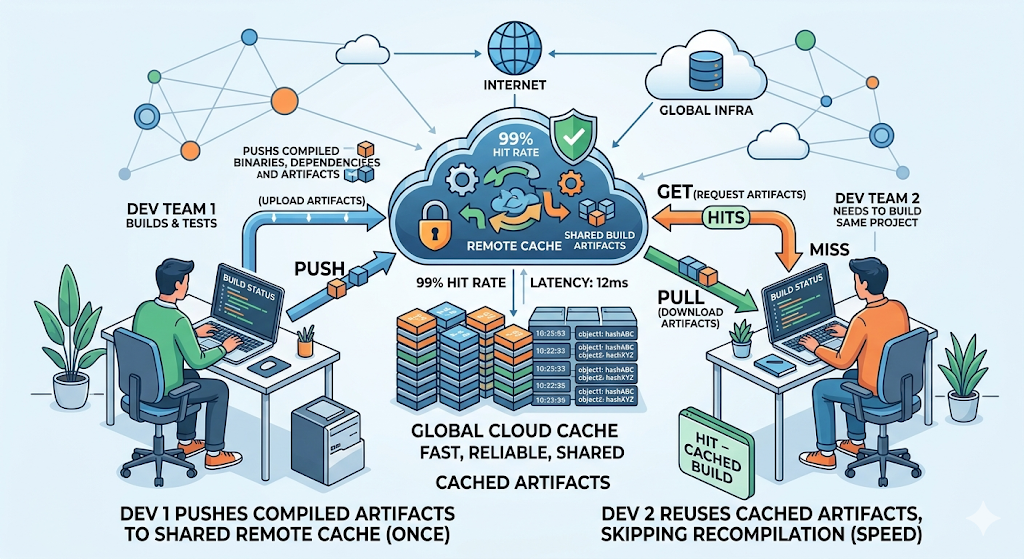
A software team managing a large Scala monorepo with 35 sub-projects faced severe build time issues. Each CI build started from scratch, causing 25-minute compile cycles that disrupted developer focus. The monorepo structure, with deep dependency graphs across connector SDKs and deployable services, meant that even trivial changes triggered extensive recompilation of downstream modules. This created a significant productivity bottleneck, with engineers frequently context-switching during builds. The team implemented a solution using Kubernetes pods, gRPC cache servers, and SBT 2's Bazel protocol support to enable incremental builds and caching, reducing total build time to approximately 11 minutes.
"When every CI build starts from scratch, your feedback loop dies. Every engineer on our team knew the ritual: push a branch, open YouTube, come back when the build was done - and your focus was gone. This is the story of how we buried that ritual - with one Kubernetes pod, a gRPC cache server, and SBT 2's built-in Bazel protocol."
"Most of our Scala backend is built as a mono-repo consisting of roughly 35 sub-projects: a core commons library, a dozen-plus connector SDKs (Google, Office365, Slack, Salesforce, and many more), and seven deployable services assembled into fat JARs. It is a cross-cutting foundation: nearly every other service in the platform depends on it, and internally its sub-projects form a deep dependency graph of their own."
"When you have that many sub-projects, build time compounds quickly. A feature branch CI run that touched a mid-level SDK would recompile not just that SDK, but every downstream module that depends on it - even if the changes were trivially small, as small as a one-character typo. On a modest build node, a full compile-and-test cycle took almost 25 minutes."
Read at Medium
Unable to calculate read time
Collection
[
|
...
]