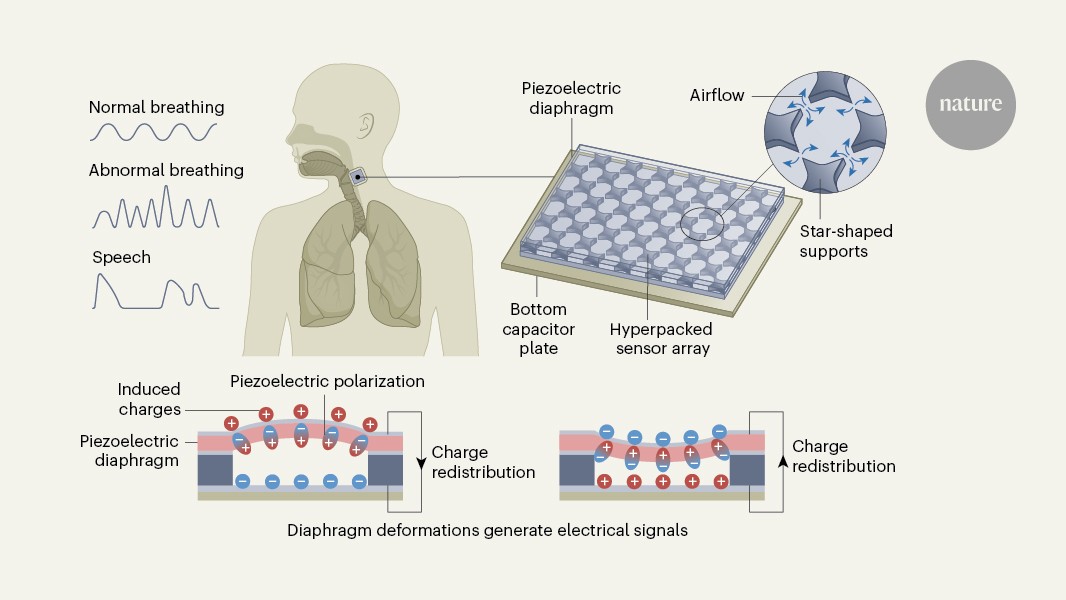
"When people breathe, speak, sing or clear their throats, their bodies are in constant motion. Air flowing through the lungs, the oscillation of vocal folds in the throat and the rhythmic expansion of the chest all produce tiny vibrations that carry valuable information about physiology and health. However, constructing a device that can capture all of these physiological signals has remained a challenge."
"Writing in Nature Sensors, Cho et al. report a wearable vibration sensor that is made from an array of densely packed electrical components called capacitors, which generate electrical signals in response to vibration. The authors' device overcomes several limitations of previous capacitor-based vibration sensors - it does not require an externally applied voltage, its electrical performance is stable when used on the skin and it can detect vibrations over a wide range of frequencies."
A wearable vibration sensor uses a densely packed array of capacitors to convert tiny body vibrations into electrical signals. The sensor captures vibrations generated by breathing, airflow, vocal fold oscillation, throat activity and chest expansion, which contain physiological information. The device operates without an externally applied voltage and maintains stable electrical performance when attached to skin. The design detects vibrations across a wide frequency range and addresses limitations of prior capacitor-based vibration sensors. The technology enables improved vibration sensing for personalized health-care monitoring and for devices that operate using human voice signals.
Read at Nature
Unable to calculate read time
Collection
[
|
...
]