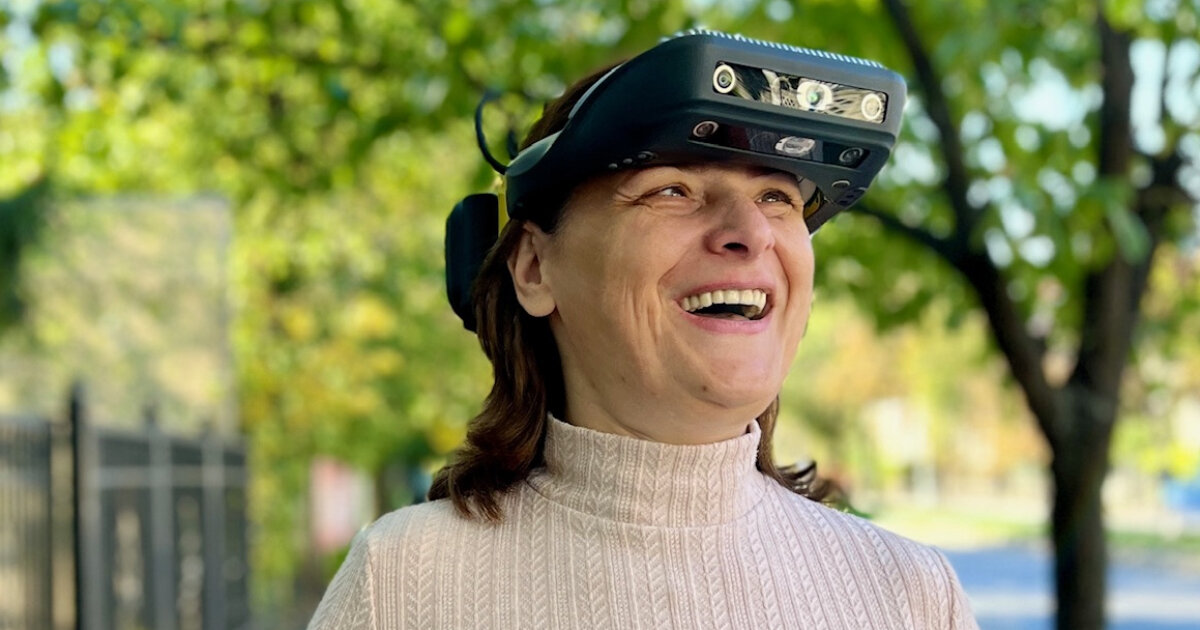
"Instead of fur and paws, the .lumen glasses use cameras, sensors, artificial intelligence, and robotics. They're worn on the head like regular glasses and act like a 'virtual guide dog.' Because of the installed technologies, the device understands and 'shows' the world around it by building a 3D picture of what is nearby. They can tell where walls, doors, stairs, sidewalks, roads, and even water are. They also understand how the user is moving and how everything else around them is moving too."
"The forehead .lumen glasses guide the blind people with vibrations around the forehead. For example, if there is an obstacle on the left, the device signals the user to turn slightly right, and if there is a clear path ahead, the head feels a pull forward. The same goes for when they need to avoid bumps on the roads, make sudden turns, and cross roads: the haptic feedback vibrates around specific points on the forehead."
"The forehead glasses for the blind people calculate paths more than 100 times every second, the team says. This system, powered by AI, allows the device to figure out where it is safe to walk and where it is dangerous. It can guide someone toward a door, help them stay on the sidewalk, or keep them away from hazards like traffic or stairs. It can also use sound to point out important objects nearby, adding another layer of information."
Forehead-mounted .lumen glasses combine cameras, sensors, artificial intelligence, and robotics to build a real-time 3D picture of nearby surroundings. The device detects walls, doors, stairs, sidewalks, roads, and water, and tracks user movement as well as nearby dynamic objects. Haptic vibrations around the forehead guide users by indicating obstacles, suggesting subtle turns, and signaling clear paths forward. The system calculates safe paths more than 100 times per second and can also use sound to point out important nearby objects. The glasses are designed to be scalable and produced more easily and at much lower cost than guide dogs, enabling safer, more independent mobility for blind people.
Read at designboom | architecture & design magazine
Unable to calculate read time
Collection
[
|
...
]