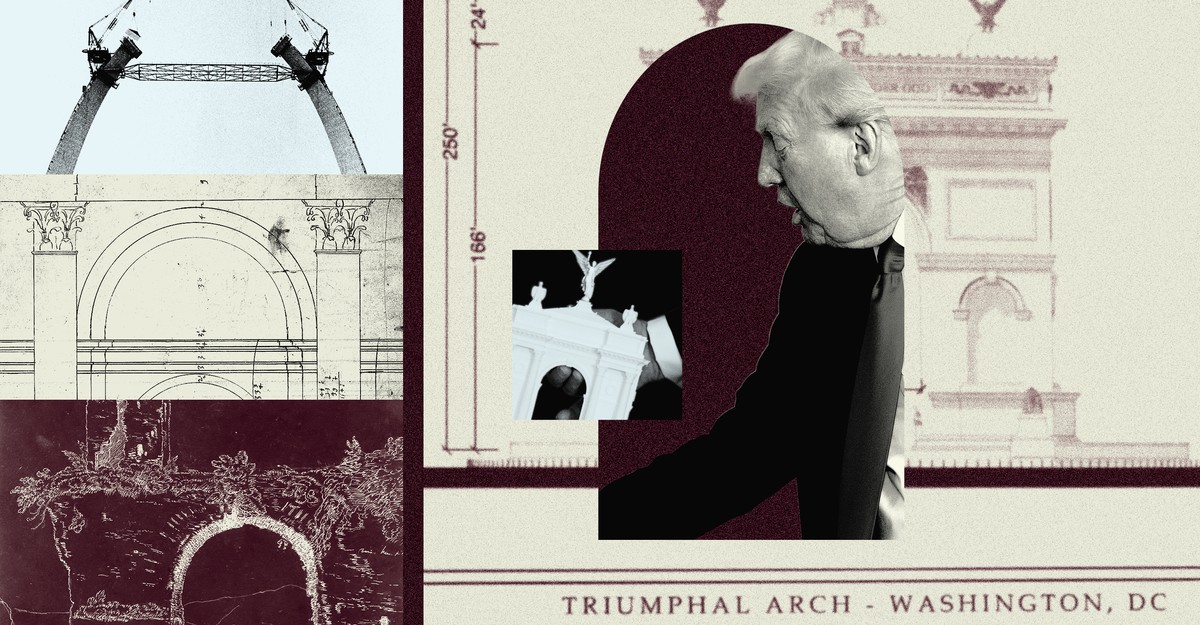
Americans have used arches since the early United States to make visual arguments about national ideals. George Washington’s 1789 welcome in Philadelphia included an arch of laurels and evergreens, and painter Charles Willson Peale helped erect a large painted arch in front of the President’s House. Arches connected the new nation to classical Europe and helped provide a legitimizing past. Artists continued using arches to celebrate republicanism and to warn about plutocratic and autocratic forces that could corrupt it. A proposed arch by President Trump would be built across the Potomac, be white with gold details, include symbolic figures and the phrase ONE NATION UNDER GOD, and would frame a view of Robert E. Lee’s home.
"When George Washington arrived in Philadelphia after his election as president in 1789, he was welcomed by an arch of laurels and evergreens. Among its erectors was the painter Charles Willson Peale, who also made a 46-foot arch of painted canvas and wood that briefly stood in front of the city's President's House, where Washington would live for the bulk of his two terms. Arches, a form that linked the new North American nation to the classical Europe that had informed the Founding Fathers' republicanism, helped give the U.S. a legitimizing past."
"Ever since, artists have used arches to celebrate U.S. republicanism, including to alert us to the plutocratic and autocratic forces that might corrupt it. In other words, they have issued warnings against the very qualities that the latest proposed arch-which President Trump wants to build across the Potomac River from Washington, D.C.-would embody."
"Trump's arch would fill a traffic circle between the west side of Memorial Bridge and Arlington National Cemetery, and form a sight line with the Lincoln Memorial. It would be white with gold details that include a winged figure, two birds, and the phrase ONE NATION UNDER GOD. At 250 feet tall, it would dwarf neighbors such as the U.S. Marine Corps War Memorial (78 feet), the White House (70 feet), and the Lincoln Memorial (99 feet)."
"Renderings of the proposed arch, which the U.S. Commission of Fine Arts approved on Thursday, indicate that the structure would provide a framed view of Confederate General Robert E. Lee's home, now a National Park Service-administered site. (The CFA is an independent federal agency that reviews architectural changes in D.C. All seven of its commissioners were appointed by Trump. The arch will go before another body, the National Capital Planning Commission, in June.)"
#american-political-symbolism #architecture-and-monuments #republicanism #washington-dc-landmarks #confederate-memory
Read at The Atlantic
Unable to calculate read time
Collection
[
|
...
]