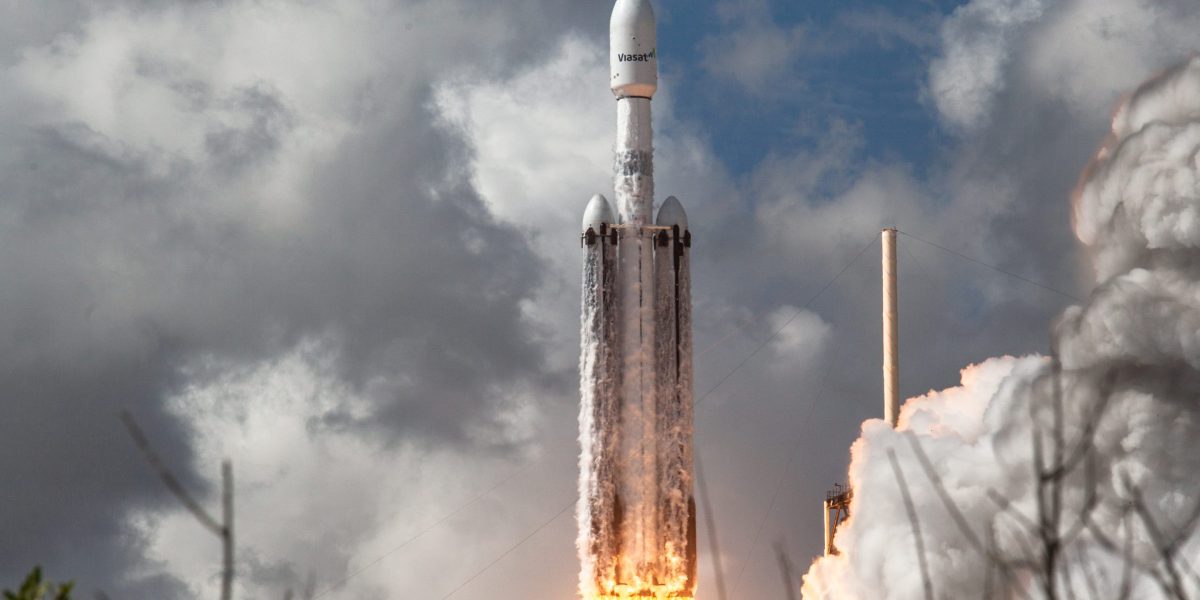
The space economy is gaining renewed attention as the U.S. and China compete for lunar missions, SpaceX pursues a Mars colony, and the Trump administration plans a space-based missile shield. Publicly traded companies already provide exposure to different parts of this market, including launch providers, satellite developers, and space-based service firms. SpaceX, founded in 2002, helped reshape launch economics by pioneering reusable, autonomously landing boosters that reduced costs and increased launch frequency. It leads global rocket launches with Falcon and Falcon Heavy and operates more than 10,000 Starlink satellites. Other companies include Rocket Lab for small-to-medium rockets and on-orbit management, Virgin Galactic for private space travel, AST SpaceMobile for space-based cellular broadband, and Voyager Technologies for space and defense systems.
"Led by the Falcon rocket and Falcon Heavy for bigger payloads, SpaceX claimed more than 80% of global rocket launches last year and has more than 10,000 Starlink satellites in orbit. But despite its emergence as the new industry leader, there's room in the growing space economy for other companies."
"For its part, Elon Musk started SpaceX in 2002 to challenge the dominance of Boeing and Lockheed Martin. By pioneering the development of reusable boosters that can land autonomously, the company slashed launch costs and ramped up its launch cadence-suddenly making low Earth orbit more accessible to a broad range of customers."
"Rocket Lab develops small and medium-class rockets, spacecraft and components while also providing launch services, satellite manufacturing, and on-orbit management."
"AST SpaceMobile plans to build a global cellular broadband network in space and is developing a constellation of BlueBird satellites."
Read at Fortune
Unable to calculate read time
Collection
[
|
...
]