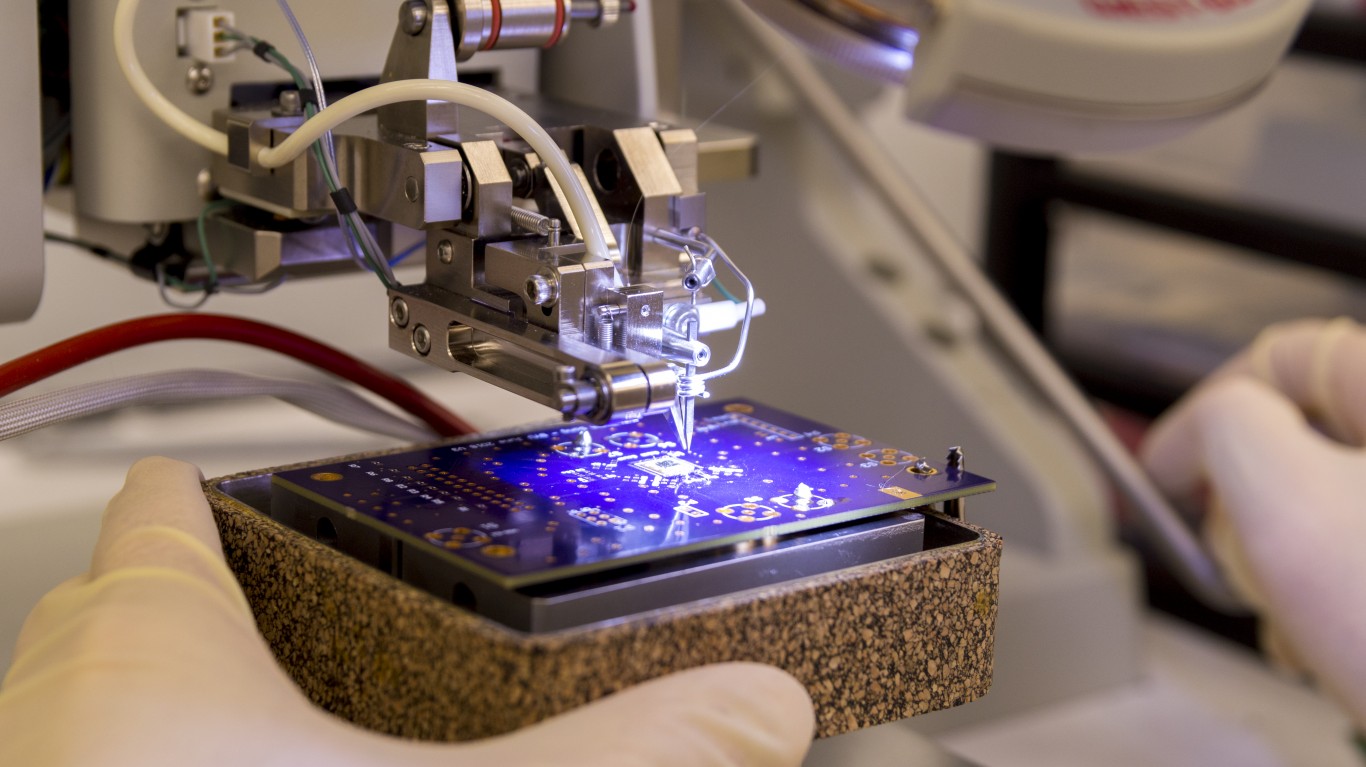
"ASML Holding ( NASDAQ:ASML ) has long dominated the semiconductor world with its stranglehold on extreme ultraviolet (EUV) lithography machines. These behemoths are the gold standard for etching nanoscale patterns onto silicon wafers, enabling the production of advanced chips packed with billions of transistors. Without EUV, the explosive growth in artificial intelligence - from training massive models like those powering ChatGPT to deploying edge devices - would grind to a halt. The precision of ASML's tech allows for chips at 3 nanometers (nm) and below,"
"Chip giants like Taiwan Semiconductor Manufacturing ( ) and Samsung rely almost exclusively on ASML's machines, which cost up to $400 million apiece and take years to build. This setup has created what amounts to a monopoly: ASML controls over 90% of the EUV market, with no scalable alternatives in sight. Until now, there has been no real rival to its business, but that may be changing."
"As executive chairman of xLight - a stealthy startup founded last year - he's gunning to disrupt the EUV status quo. xLight targets the heart of lithography: light sources. While ASML's EUV relies on laser-produced plasma at 13.5 nanometers, xLight is developing free-electron lasers driven by compact particle accelerators. These could hit wavelengths as low as 2nm, potentially doubling transistor density every two years and reviving Moore's Law from its "nap," as Gelsinger puts it."
ASML controls the EUV lithography market and enables production of sub-3nm chips essential for advanced AI and energy-efficient devices. Major foundries like TSMC and Samsung depend on ASML's machines, which can cost up to $400 million and take years to build, producing a de facto monopoly with over 90% market share and few scalable alternatives. xLight, led by Pat Gelsinger as executive chairman, is developing free-electron lasers and compact accelerators to produce much shorter wavelengths near 2nm, promising faster transistor density increases. The U.S. announced up to $150 million in CHIPS Act funding for xLight.
Read at 24/7 Wall St.
Unable to calculate read time
Collection
[
|
...
]