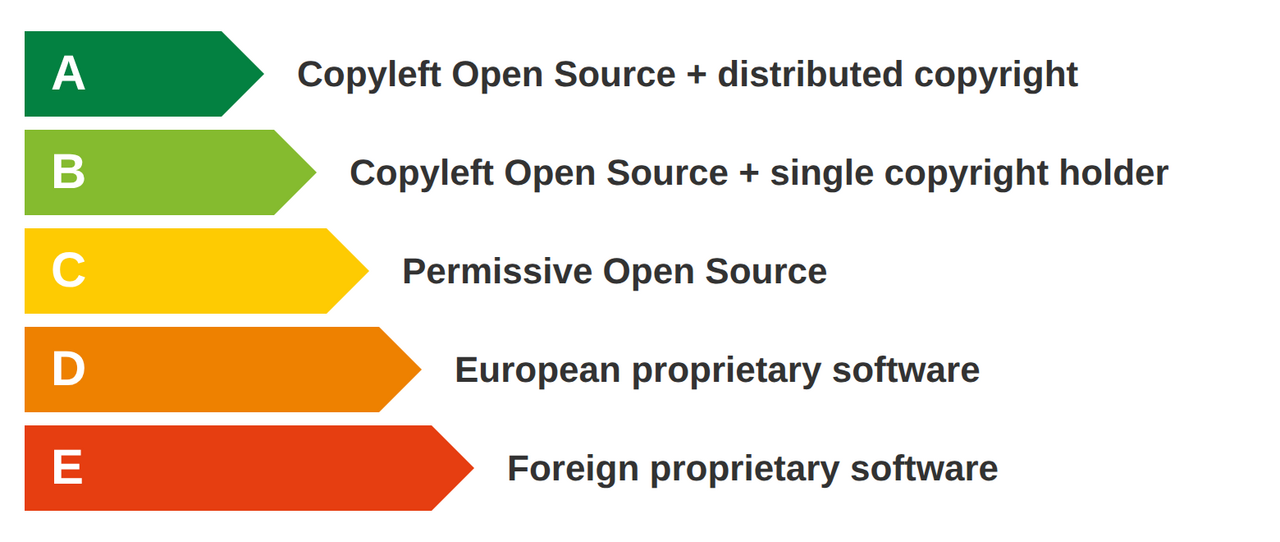
""Buy European" is becoming Europe's rallying cry for digital sovereignty. The logic is intuitive: if you want independence from American technology, buy from European companies instead. However, I think "Buy European" gets one thing right and one thing wrong. It's right that Europe benefits from a stronger technology industry. But buying European does not guarantee sovereignty. Sovereignty is not about where a company is headquartered or where software was originally written. It is about who ultimately controls the technology, and that control can change."
"Sovereignty has two dimensions: how much control you have today, and how much of that control is structural, built into the legal foundations. The proposed scale measures the second. It evaluates how resilient software is to change, whether through acquisition, relicensing, or loss of critical funding. I used five levels, modeled on Europe's familiar A-through-E labels for energy efficiency and food nutrition, from structurally sovereign to fully dependent."
Digital sovereignty depends less on where software originates and more on who ultimately controls it. Buying from local vendors strengthens the industry but does not guarantee lasting control. The crucial question is whether the software can be taken away through acquisition, relicensing, or funding loss. Sovereignty includes current operational control and structural control embedded in legal foundations. A proposed five-level A-to-E scale rates structural resilience, from structurally sovereign to fully dependent. Permissive open-source licenses offer partial protection because derivatives can be closed; proprietary foreign software provides no modification rights and binds users to vendor jurisdiction.
Read at Dri
Unable to calculate read time
Collection
[
|
...
]