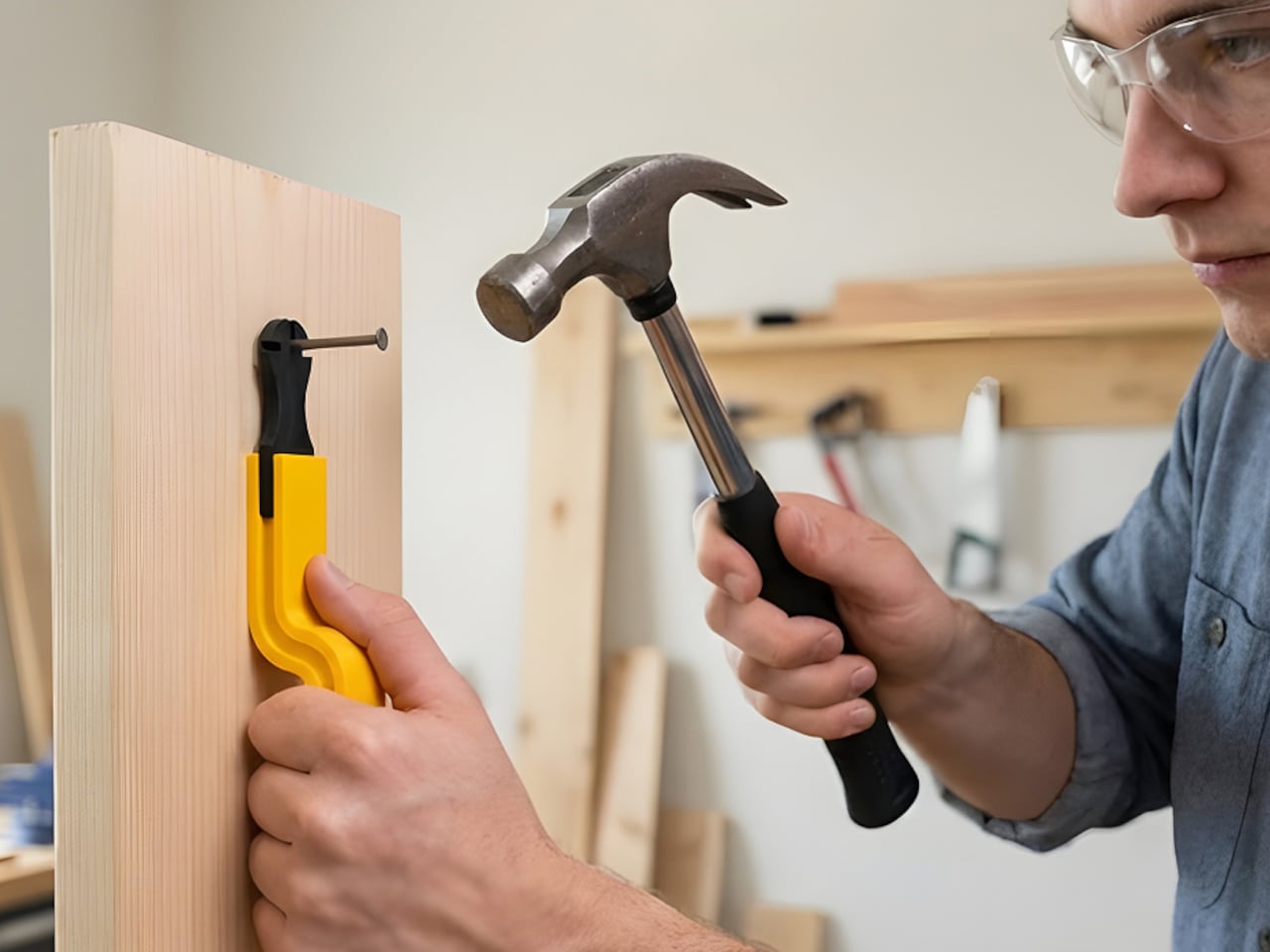
"Nailmate is a hand-held positioning tool made from ABS plastic with a TPU rubber gripping head. It holds a nail upright while keeping the user's fingers well below the impact zone, with no springs, clamps, or adjustable parts to configure before the first swing. The elongated form puts meaningful distance between the hand and where the hammer lands."
"Existing nail-holding solutions have real shortcomings worth naming. Small plastic holders keep fingers close enough to still be at risk. Plier-style holders work but are bulky enough that most people leave them in a drawer. Magnetic holders struggle with heavier nails and offer no guarantee against slipping. Nailmate addresses all three failure modes by doing less mechanically and more through considered geometry."
"The tool comes in three variants, each color-coded for different working conditions. The red Stable version is built for flat, open surfaces like wooden boards or wall panels, where the hammer has a full vertical swing. The teal Expanded version has a wider horizontal head that supports a nail from multiple contact points, for situations where a perfectly vertical swing is not possible."
Nailmate addresses the common hazard of striking fingers while hammering nails by using a simple hand-held positioning tool made from ABS plastic with a TPU rubber gripping head. The tool keeps nails upright while maintaining meaningful distance between the user's hand and the hammer's impact zone, eliminating the need for springs, clamps, or adjustable parts. Existing solutions like small plastic holders, plier-style holders, and magnetic holders each have significant shortcomings. Nailmate comes in three color-coded variants designed for different working conditions: the red Stable version for flat surfaces with full vertical swings, the teal Expanded version for situations without perfectly vertical swings, and the yellow Precise version for curved or edge-based surfaces. The color distinction serves practical purposes on cluttered workbenches.
Read at Yanko Design - Modern Industrial Design News
Unable to calculate read time
Collection
[
|
...
]