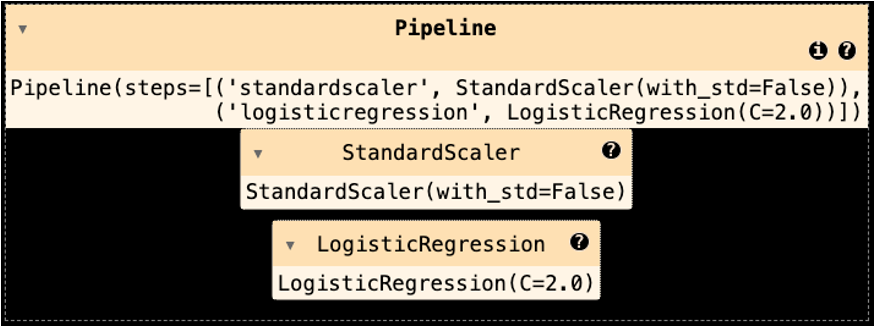
"User experience (UX) has always been an important focus for scikit-learn. As we know, UX encompasses many aspects, but here we will focus specifically on how easy it is for the user to understand scikit-learn models during development, especially while using tools like jupyter notebooks. First visualizations Initial work to allow users to inspect their models interactively began in 2019, when Thomas J. Fan introduced HTML visualizations for estimators. He continued to build on this foundation with additional improvements in subsequent contributions."
"This was until the end of 2023, when Guillaume Lemaitre applied for a grant with the help of NumFOCUS, that the broader topic of Predictive model evaluation and inspection was formalized. Enhancing user experience through interactive inspection is an essential part of this effort and falls within the scope of the grant. The grant was awarded to scikit-learnand it is from the Chan Zuckerberg Initiative (CZI) through its Essential Open-Source Software for Science (EOSS) program."
Scikit-learn focused on improving UX for interactive model inspection in notebooks. Initial HTML visualizations were introduced in 2019 by Thomas J. Fan and were incrementally improved. An issue listing enhancements opened in June 2023 but remained unresolved for about a year and a half due to resource constraints. A grant application formalized predictive model evaluation and inspection work; the grant was awarded via CZI's EOSS program funded by the Wellcome Trust and administered by NumFOCUS. Work funded by the grant is underway and several objectives have already been completed. Version 1.7 (June 2025) added an interactive parameters table showing names and values.
Read at scikit-learn Blog
Unable to calculate read time
Collection
[
|
...
]