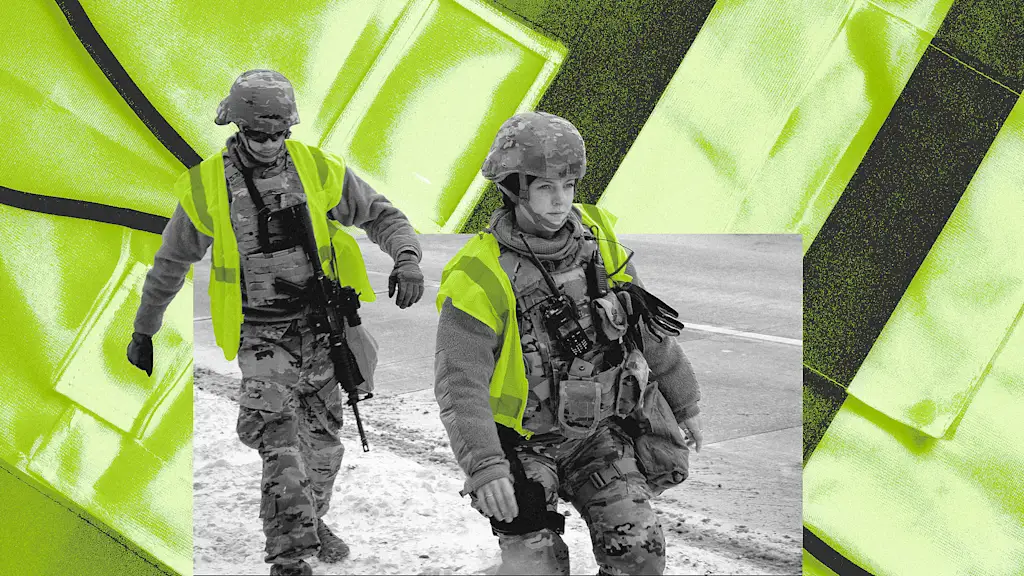
"From a design perspective, the whole point of uniforms is to provide an instant visual signal. But that mission has been thwarted in the ongoing besiegement of the Twin Cities by thousands of officers from Immigration and Customs Enforcement (ICE), Customs and Border Protection, and other federal agencies. Most notably, many sport camouflage and gear that civilians tend to associate with the military. The upshot is that it's become harder for the average person to understand at a glance who is there to do what."
"Certainly the presence of uniformed members of multiple agencies seems out of hand when the National Guard has to start wearing crossing guard vests to distinguish themselves. The situation would be comical if it weren't so bleak, as if it's apparently become necessary for members of the U.S. military to visually announce, "hey we're here to help, not an occupying army or a threat.""
"In a way, this throws into sharp relief how effective the ICE aesthetic has been in projecting a quasi-militaristic version of federal law enforcement. The agency's look has been attracting attention for months as it has pursued undocumented immigrants (or just people it suspects might be) in crackdowns in Chicago, New Orleans, Minneapolis, and elsewhere, often showing up at work sites or public spaces in what resembles military tactical gear, body armor, weapons, and masks."
State authorities announced that the Minnesota National Guard would stand by to assist local law enforcement around Minneapolis-St. Paul, and that activated members would wear reflective vests to distinguish them from other agencies. Uniforms normally provide an instant visual signal, but thousands of officers from ICE, Customs and Border Protection, and other federal agencies have appeared in camouflage and tactical gear resembling military outfits. That convergence of looks has made it harder for civilians to tell who is performing which public-safety role. The ICE aesthetic projects a quasi-militaristic federal law enforcement presence during immigration crackdowns in multiple cities. Agents mix street clothes with military-pattern gear and patches.
Read at Fast Company
Unable to calculate read time
Collection
[
|
...
]