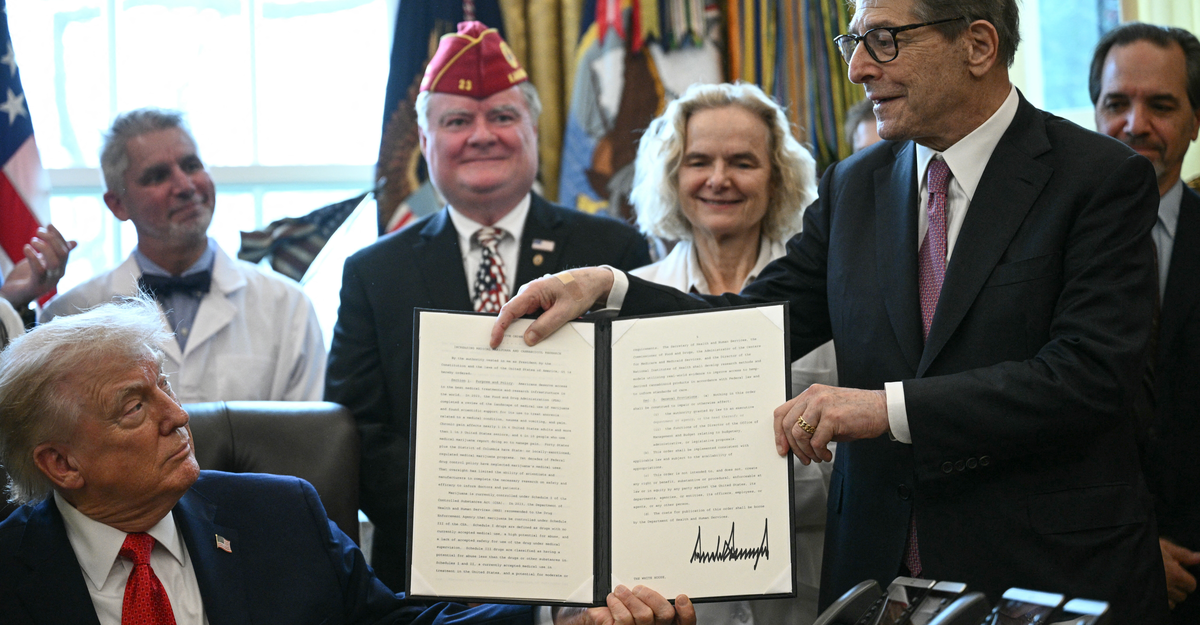
"President Donald Trump signed an executive order today that committed the Justice Department to "rescheduling" marijuana. Although the order won't legalize pot, it will relax a series of restrictions that the federal government has long enforced. The move has a broad coalition of supporters, including many progressives, who say that it will enable medical research and alleviate mass incarceration. But in reality, rescheduling marijauna will do little more than hand a tax break to the corporations that spent millions of dollars lobbying for it."
"The term rescheduling comes from the Controlled Substances Act, the legal foundation of America's drug-control regime. Under the CSA, controlled drugs (as opposed to uncontrolled ones, such as acetaminophen and ibuprofen) are sorted into five schedules. For decades, the government has listed marijuana under Schedule I, which it reserves for drugs that have no accepted medical use and a high potential for abuse. If the administration's plan goes through, marijuana will shift to Schedule III, a classification for drugs that have a medical use and a relatively low potential for abuse or dependence."
"Contrary to conventional wisdom, pot-especially today's highly potent product-is both addictive and harmful. Figures vary, butthe CDC estimates that about 30 percent of users become addicted. Moreover, research has linked marijuana use to a range of health risks. Recent meta-analyses have found strong and persistent associations between marijuana use and heart disease, stroke, lung disease, loss of IQ, psychotic events, and schizophrenia."
An executive order commits the Justice Department to rescheduling marijuana, which will not legalize it but will relax several longstanding federal restrictions. Supporters, including some progressives, argue rescheduling will enable medical research and reduce mass incarceration. The proposal would move marijuana from Schedule I to Schedule III under the Controlled Substances Act, signaling accepted medical use and lower perceived abuse potential. Current scientific evidence indicates marijuana can be addictive and harmful; the CDC estimates about 30 percent of users become addicted. Research links marijuana use to heart disease, stroke, lung disease, reduced IQ, psychotic events, and schizophrenia.
Read at The Atlantic
Unable to calculate read time
Collection
[
|
...
]