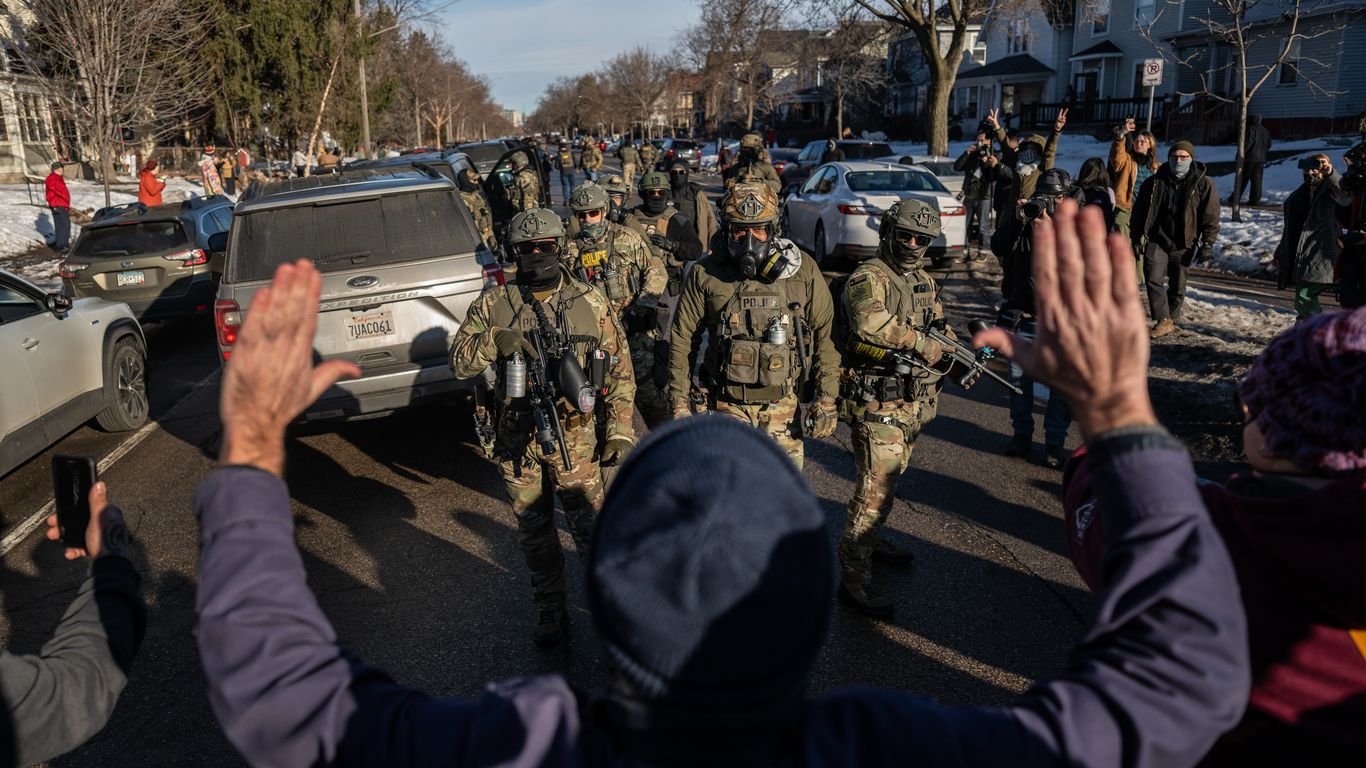
President Trump threatened to invoke the Insurrection Act to deploy federal troops unless state officials stop "professional agitators and insurrectionists" from attacking ICE. Protests erupted nationwide after the fatal shooting of Renee Good, with Minnesota becoming a focal point for clashes between demonstrators and federal agents. Governor Walz called the federal actions "a campaign of organized brutality" and an "occupation" of Minnesota. An ICE agent shot a Venezuelan man during what DHS described as an ambush. The Insurrection Act authorizes domestic troop deployments, with some provisions requiring state consent and others allowing enforcement of laws, suppression of rebellion, or response to domestic violence depriving constitutional rights. Legal scholars warn the authority is ripe for misuse and advocate narrowing its scope.
"The provisions of U.S. code that make up the Insurrection Act give the president the authority to deploy troops on American soil. One section requires state consent. The others do not. Those other sections allow him to deploy troops to enforce laws, suppress rebellion or respond to "domestic violence" that deprives people of their constitutional rights."
"Between the lines: The Brennan Center calls it the "primary exception" to the Posse Comitatus Act, which bars federal troops from civilian law enforcement. The Posse Comitatus Act emerged in legal debates over the president's recent deployments. A federal judge ruled Trump's use of the National Guard in the L.A. area ran afoul of it."
"The Insurrection Act should only be invoked in the most extreme circumstances,"
Read at Axios
Unable to calculate read time
Collection
[
|
...
]