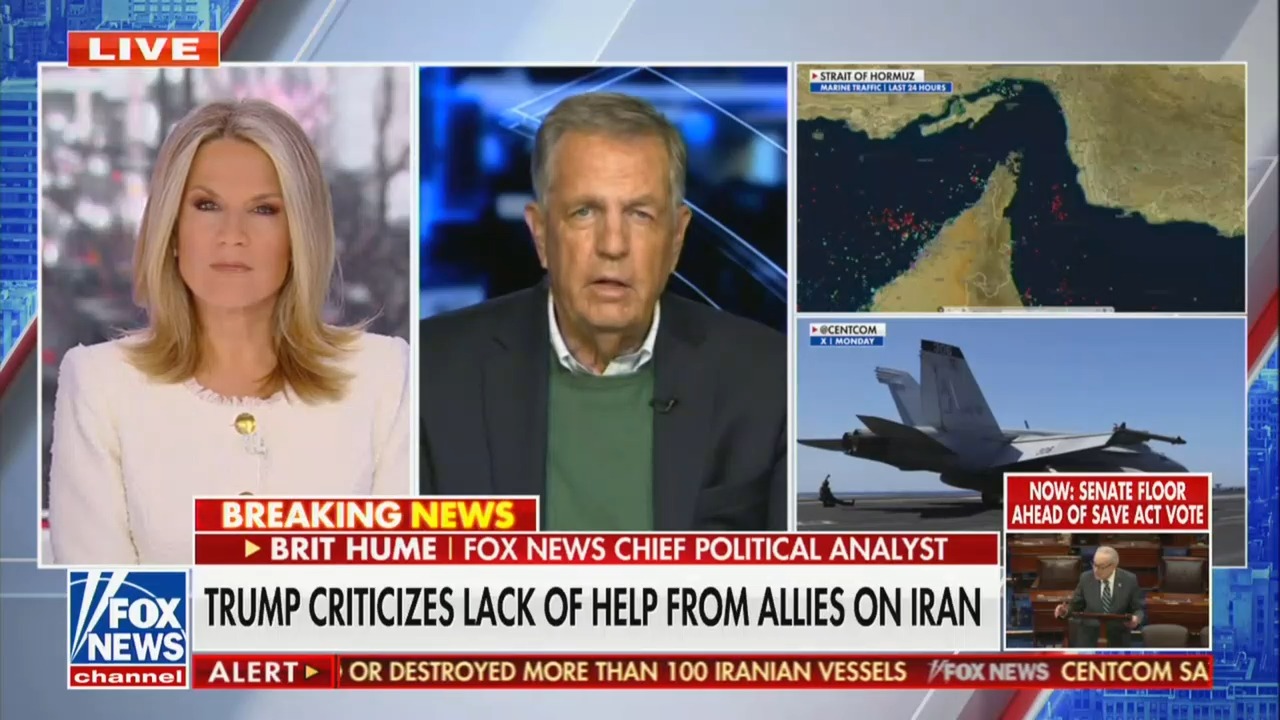
"For a moment, Martha, let's turn the situation around and assume a situation in which the United States is under attack from a major enemy. And that enemy is ranging freely over our skies with no resistance, bombing at will, sending missiles at will, attacking our vessels, attacking our ballistic missile systems, attacking our aircraft at will. That they have wiped out-, they've killed the president and wiped out his Cabinet, and countless officials in the echelons below."
"And we have responded as the United States by shutting off a major waterway that we need for our economy yes it harms other economies as well. Do you think anyone would be saying that this is, as Walter Russell Mead put it today, a stalemate? I don't think so."
"Yeah, no, it's a great point, and it always helps to flip something around and think about what the coverage would be like in that situation. And people wouldn't be saying of those who are invading us or firing missiles all over our country and killing the president, Gee, I wonder why they haven't defined how long it's going to take."
Brit Hume responded to media criticism of the Trump administration's Iran operation by presenting a hypothetical reversal. He described a scenario where the United States faced sustained attacks from a major enemy with air superiority, resulting in the death of the president and cabinet members. In this reversed situation, Hume argued that a U.S. response—such as blocking a major waterway—would not be characterized as a stalemate or criticized for lack of preparation. He suggested the media's framing would differ dramatically if America were defending itself rather than initiating action. Martha MacCallum agreed, noting that critics would not question the timeline of a defensive response against invading forces.
Read at www.mediaite.com
Unable to calculate read time
Collection
[
|
...
]