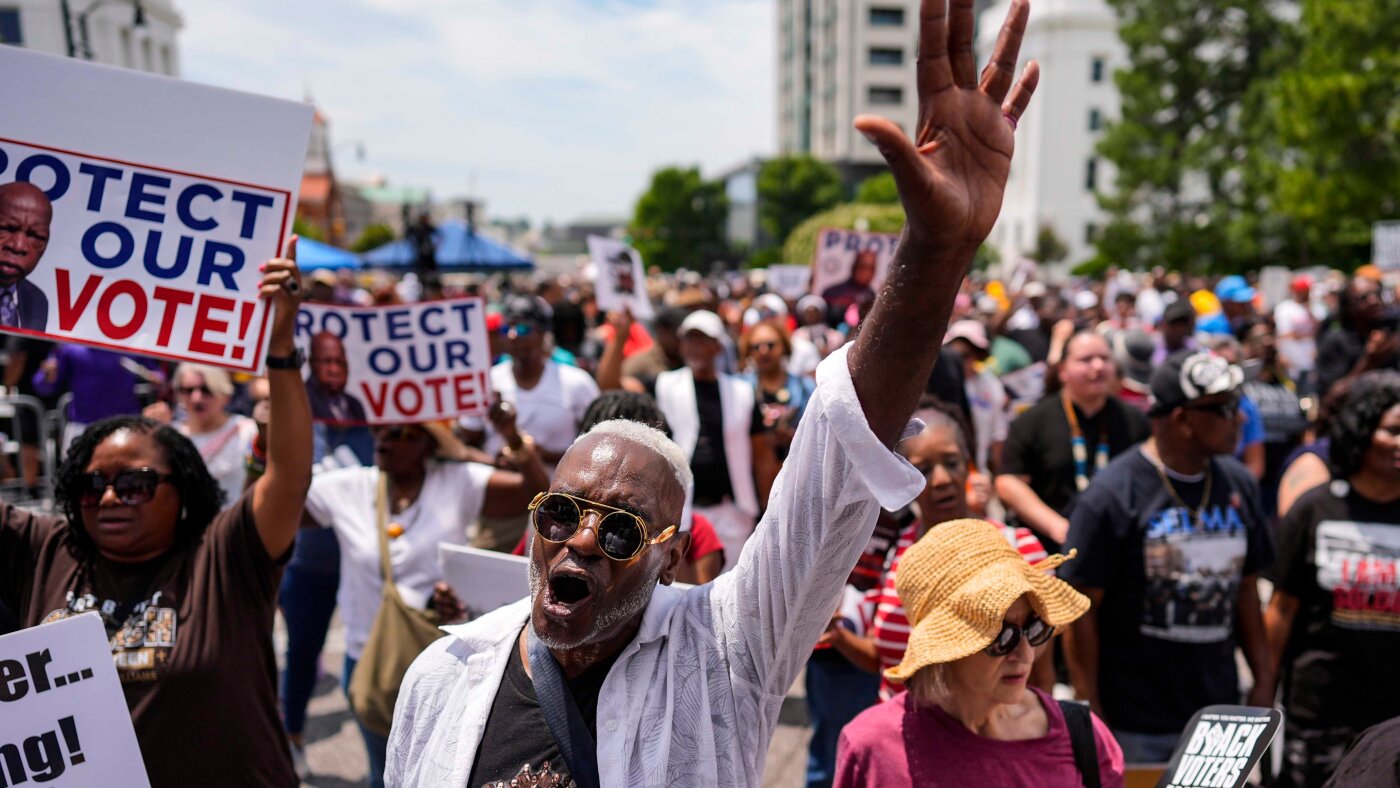
"In 1965, Black Americans peacefully demonstrated for voting rights and were beaten by Alabama state troopers before returning two weeks later to complete their march under federal protection. Keith Odom was a toddler then. Now 62 years old, the union man and grandfather of three retraced some of their final steps. On Saturday, he came from Aiken, South Carolina, to Atlanta, where he joined several dozen other activists on two buses to Montgomery, Alabama."
"A few hours later, he stepped off his bus and onto Dexter Avenue, where the original march concluded. "The history here being a part of it, seeing it, feeling it," said Odom, who is Black. His voice trailed off as he saw the Alabama Capitol and a stage that sat roughly where the Rev. Martin Luther King Jr. concluded the original march. Odom lamented that he and his fellow bus riders were not simply commemorating that seminal day in the Civil Rights Movement."
"Instead they came to renew the fight. The 1965 effort helped push Congress to send the Voting Rights Act to Democratic President Lyndon B. Johnson to sign, securing and expanding political power for Black and other nonwhite voters for more than a half-century. Saturday's "All Roads Lead to the South" rally was the first mass organizing response after a U.S. Supreme Court ruling that severely diminished that landmark law."
"Striking down a majority Black congressional district in Louisiana, the justices concluded in a 6-3 ruling that considering race when drawing political lines is in itself discriminatory. That spurred multiple states, including Alabama, to redraw U.S. House districts in ways that make it harder for Black voters, who lean overwhelmingly Democratic, to elect lawmakers of their choice. "I'm not trying to live a life that's going backwards," Odom said. "I want to go forward, for my grandchildren to be able to go forward.""
In 1965, Black Americans demonstrated peacefully for voting rights in Alabama and were beaten by state troopers, then returned two weeks later to complete their march under federal protection. Keith Odom, now 62, retraced the final steps from Atlanta to Montgomery, stepping onto Dexter Avenue where the original march ended. He said the purpose was not only commemoration but renewing the fight. The 1965 campaign helped lead to the Voting Rights Act signed by President Lyndon B. Johnson, securing political power for Black and other nonwhite voters for decades. A recent U.S. Supreme Court ruling diminished the Voting Rights Act by treating race-based districting as discriminatory, prompting states to redraw districts in ways that make it harder for Black voters to elect preferred candidates.
Read at www.npr.org
Unable to calculate read time
Collection
[
|
...
]