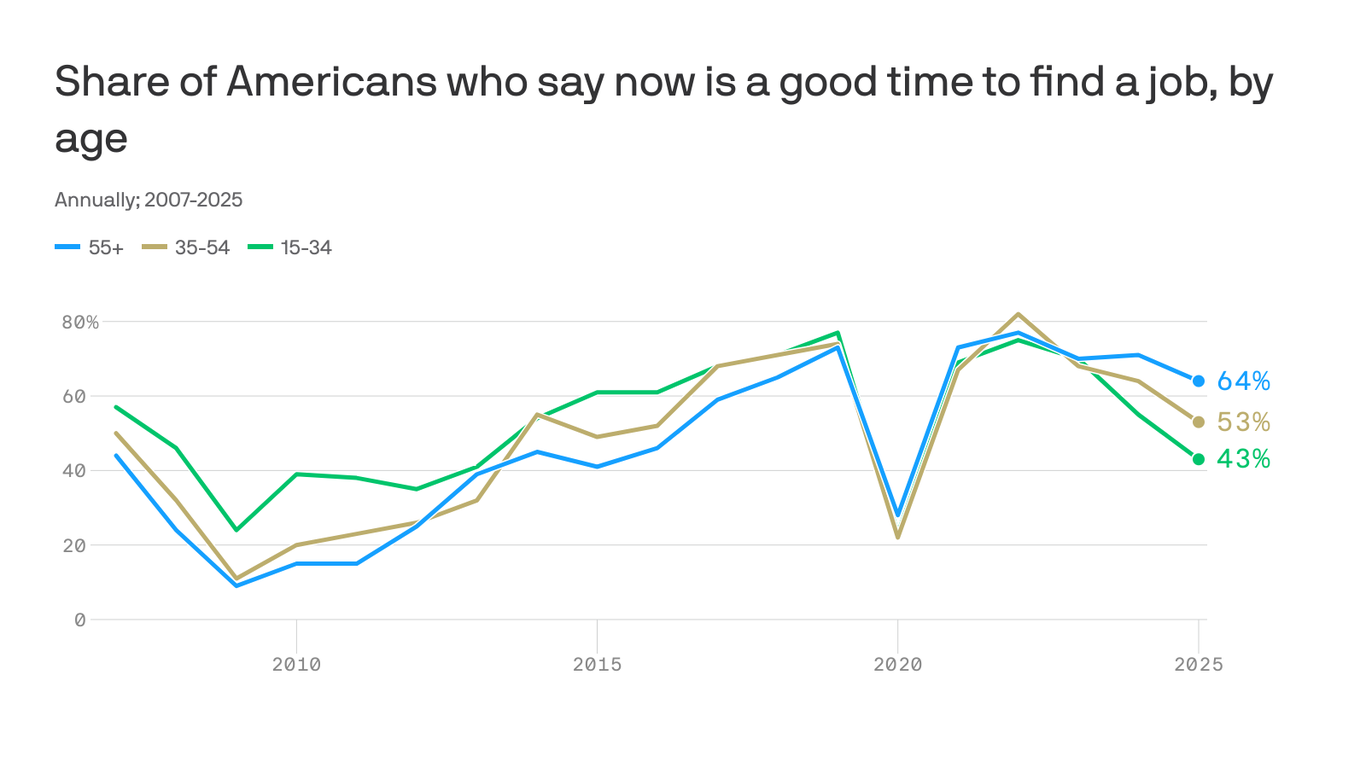
"Only 43% of those aged 15 to 34 in the U.S. thought it was a good time to find a job locally in 2025 compared to 64% of those 55 and older - a 21-point gap. There is a 12-point gap between China's older and younger generations, and similar divides in Serbia, the UAE, Hong Kong and Norway. The global median is a 10-point divide, except it's the older adults who are more pessimistic."
"Younger Americans rated their job prospects lower earlier in the 2000s, but they were still more positive than older people. They were also more positive than a significant share of their peers globally in 2025, ranking 87th out of the 141 countries surveyed. In South Korea last year,just 28% of the youth said it was a good time to find a job - but that was on par with the 25% of those 55 and up who agreed."
"The biggest drop in positive outlook came from young Americans who have higher education and aren't yet working full time, Benedict Vigers, a senior news writer with Gallup who analyzed the data, says. "It's likely that there's a fair amount of sort of AI baked into that decline," he says."
"Artificial intelligence gutting entry-level roles and a corporate landscape often heavily reliant on social capital over qualifications contribute to the pessimism, Sam Hiner, the co-founder and executive director of the Young People's Alliance, says. "We're cutting the career ladder off at the beginning," Hiner, 23, tells Axios Case in point: Amelia Sexton, a 19-year-old sophomore at the University of North Carolina at Chapel Hill, tells Axios she applied for 30 summer jobs. She received no response"
Young people across several countries are more discouraged about finding local jobs than older adults. In the United States, 43% of those aged 15 to 34 viewed 2025 as a good time to find a job locally, compared with 64% among those 55 and older. Similar generational gaps appear in China, Serbia, the UAE, Hong Kong, and Norway, with a global median divide of 10 points. In many places, older adults are more pessimistic. Earlier in the 2000s, younger Americans rated job prospects lower but remained more positive than older people. In 2025, the youth in South Korea reported especially low optimism, and the largest decline in the U.S. came among highly educated young people not yet working full time. AI is suggested to be contributing to the decline, alongside corporate reliance on social capital and fewer entry-level career ladders.
#job-market-optimism #generational-differences #artificial-intelligence #youth-employment #global-labor-sentiment
Read at Axios
Unable to calculate read time
Collection
[
|
...
]