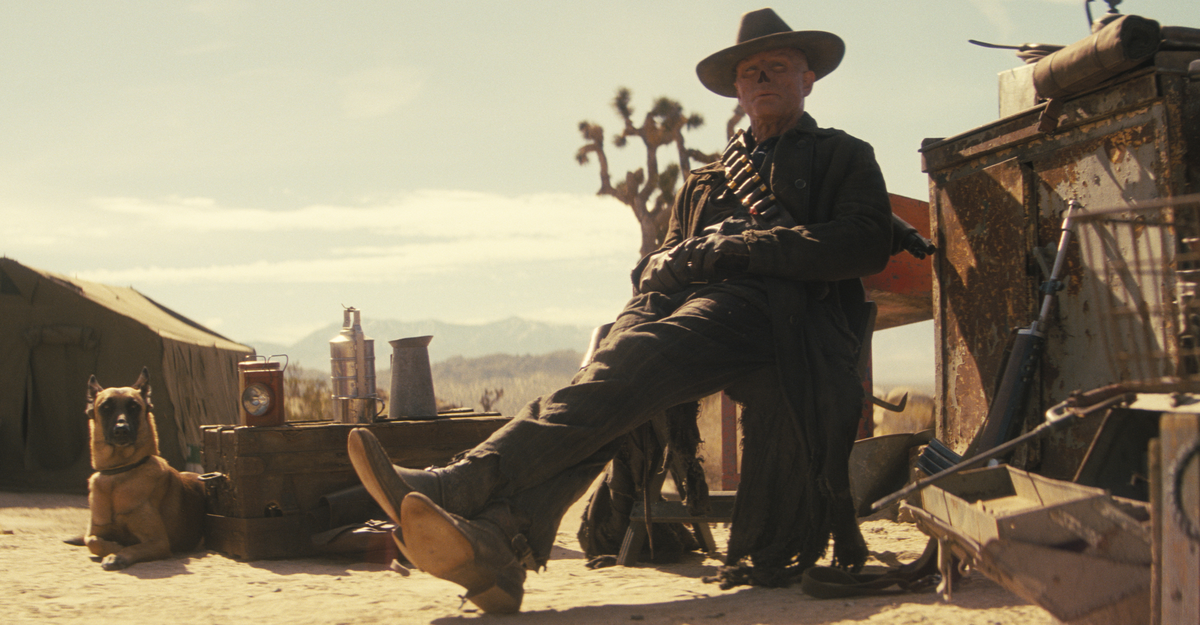
""I didn't look at them as Walton. I really looked at them as Cooper Howard," he told me last spring on the set of Fallout's second season. "It was like ..." He slipped into character, making a dejected expression as if envious of Ladd's career. "Okay, yeah, Alan got that role, and he was great in Shane," Goggins, as Cooper, drawled. "I should have taken that, and I should have taken that television pilot." He laughed. "I should have done Gunsmoke. Why didn't I do that?!""
""But the other half of the time, Goggins explained, he just needed something to stay sane. He also plays "the Ghoul," a mutated form of Cooper who became a deadly bounty hunter after surviving the end of the world. In many episodes, Goggins switches between playing the Ghoul (in the present) and Cooper (in flashbacks). When he had to sink into the Ghoul's ruthless mindset-and spend hours getting prosthetics applied-the actor immersed himself in tales of gunslingers, he said, so "I don't lose my mind.""
Walton Goggins watched a Western every day for more than seven months while filming Fallout. He alternated between studying classic Westerns to research Cooper Howard, a fictional 1950s–style movie star, and watching to stay sane while preparing the Ghoul, a mutated bounty hunter survivor. Goggins sees Cooper as a peer of cowboy actors like Alan Ladd and slips into Cooper's envy and regret. The Ghoul and Cooper alternate across present-day and flashback scenes, and prosthetics and mindset work demand intense immersion. Fallout reimagines a retro‑futuristic post–World War II society undone by nuclear war and set more than 200 years later, shifting tone from dystopian horror to other genres.
Read at The Atlantic
Unable to calculate read time
Collection
[
|
...
]