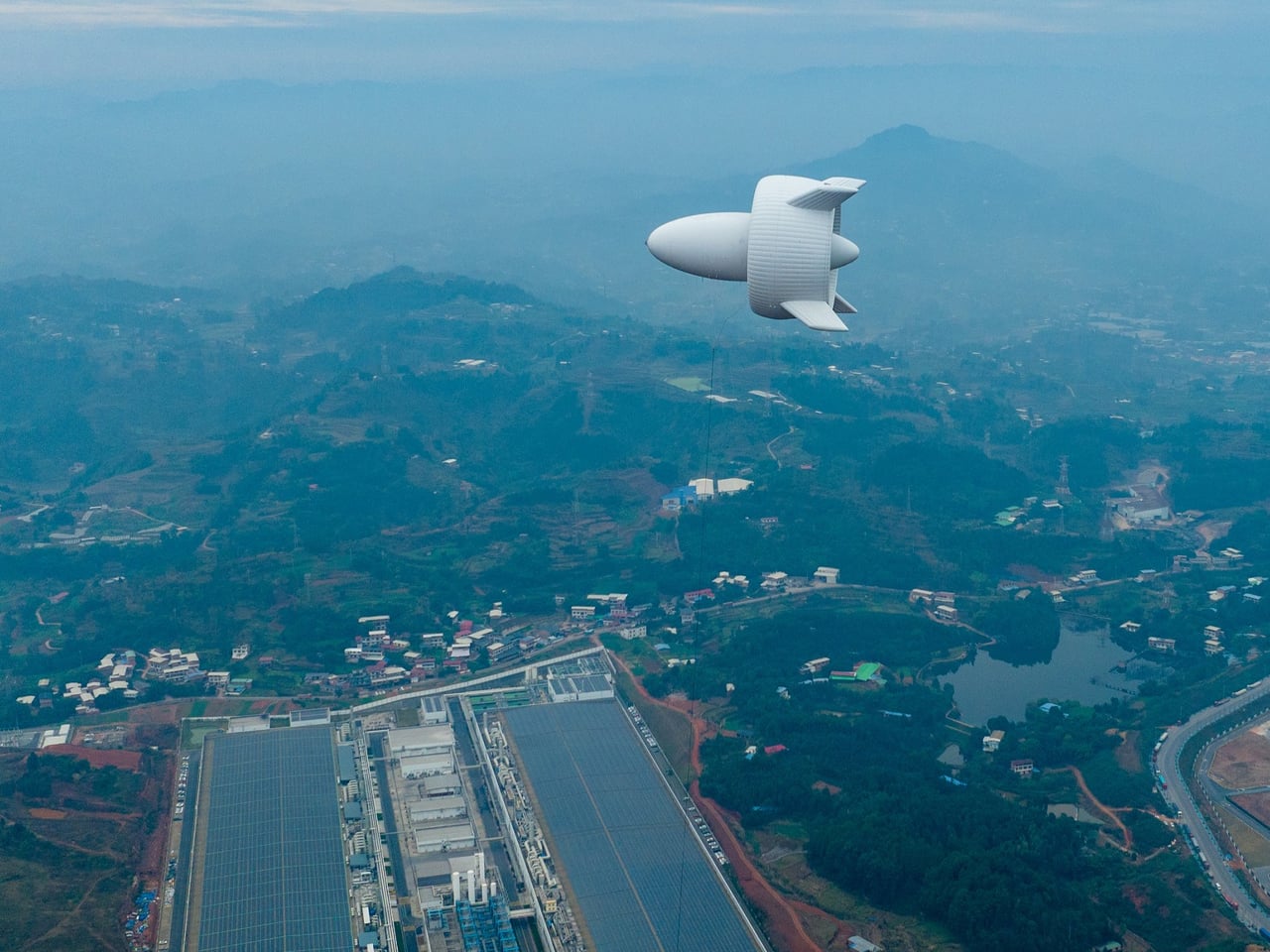
An airborne wind turbine airship S2000 SAWES completed its maiden in-flight grid-connected power generation test over Yibin, Sichuan, delivering 385 kilowatt-hours to the local grid from 2,000 meters altitude. The S2000 was developed by Beijing Linyi Yunchuan Energy Technology and is designed for use near urban areas. The platform integrates an airship and turbines in a helium-filled unit about 20,000 cubic meters and roughly 60×40×40 meters. The system has a maximum rated capacity of 3 megawatts, can hover stably while transmitting electricity to the grid, and offers an alternative to land-based turbines with reduced land use and steadier high-altitude winds.
"An object shaped like an inflatable airship was seen floating over Yibin, Sichuan Province in Southwest China earlier this month. Turns out, it wasn't some unidentified object. In fact, it was an airborne wind turbine completing its maiden in-flight grid-connected power generation test. The airborne wind energy system comprises an airship platform and wind turbines integrated in a single unit resembling a fantasy airship."
"Dubbed the world's first MW-class S2000 Stratosphere Airborne Wind Energy System (SAWES), it is developed by Beijing Linyi Yunchuan Energy Technology and designed for use near urban areas. Its successful testing marks a demonstration of how an airborne wind power system can generate and transmit electricity down for real-world usage. Designer: Beijing Linyi Yunchuan Energy Technology Wind turbines on the ground require a massive land area, tend to have low efficiency, and end up spoiling the landscape."
"The company behind the S2000 says that their Stratosphere Airborne Wind Energy System could be a difference, which definitely is not cost-effective, but is actually viable and an environmentally-friendly choice. During its testing, the floating power platform was able to rise up to about 2,000 meters, successfully delivering 385 kilowatt-hours of electricity to the local grid. The S2000 SAWES has a volume of about 20,000 cubic meters and, according to press information, has a maximum rated power capacity of 3 megawatts."
"The system measures 60 meters long, is 40 meters high, and also 40 meters wide. The big thing took almost 30 minutes to ascend to 2,000 meters in the Yibin test. When at that altitude, it was able to maintain a stable hover, while generating power and delivering it back to the grid. The system basically uses a helium-filled balloon to get the power generation unit high into the atmosphere, where winds are generally stronger and more consistent than those near the ground."
Read at Yanko Design - Modern Industrial Design News
Unable to calculate read time
Collection
[
|
...
]