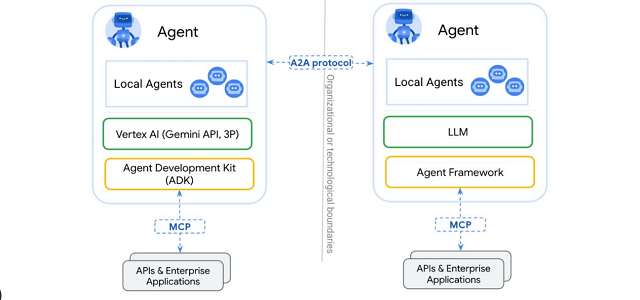
"AI agents are getting more capable, but they are also getting more fragmented. One team builds with LangGraph, another uses Google ADK, another experiments with Microsoft's framework, and someone else wires everything together with custom orchestration. The result is a familiar enterprise problem: promising systems that do not naturally work together. That is the gap the Agent2Agent (A2A) Protocol is designed to close."
"As organizations move from simple chatbots to more complex agentic workflows, interoperability is becoming a core engineering concern. A single agent may reason, call tools, retrieve context, and complete multi-step tasks. But in production settings, the real opportunity often lies in multiple agents collaborating across functions, teams, and even companies. That only works well if they can communicate through a shared standard."
"The A2A protocol introduces that shared language. It gives developers a structured way for agents to discover one another, exchange tasks, and coordinate work without requiring every agent to be built on the same framework or model stack."
"A common pattern in agentic AI is specialization. One agent handles research, another manages policy or compliance, another interacts with APIs, and another synthesizes results for the user. That structure is intuitive because it mirrors how human organizations divide work. The problem is that agent frameworks are not automatically compatible with one another. Even when two agents perform useful roles, they may not share the same assumptions about message formats, task state, discovery, authentication, or response handling."
AI agents are becoming more capable while becoming more fragmented across different frameworks and orchestration approaches. As organizations move from chatbots to multi-step agentic workflows, interoperability becomes a core engineering concern. Single agents can reason, call tools, retrieve context, and complete tasks, but production value often comes from multiple agents collaborating across functions, teams, and companies. Collaboration requires a shared communication standard. The A2A protocol introduces that shared language, enabling developers to structure agent discovery, task exchange, and coordination without requiring all agents to use the same framework or model stack. Specialization among agents increases the need for compatibility, since differing assumptions about message formats, task state, discovery, authentication, and response handling otherwise force custom integration glue code.
Read at Medium
Unable to calculate read time
Collection
[
|
...
]