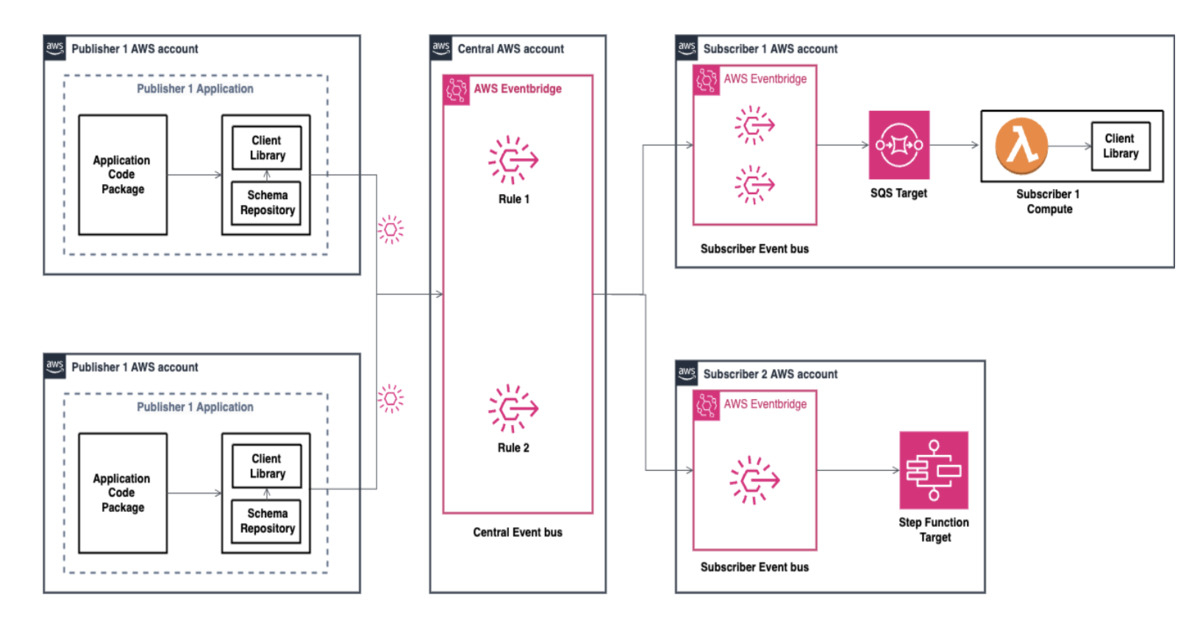
"Its earlier architecture relied on tightly integrated services, where changes or failures in one component could directly affect others. Event routing logic was manually implemented and lacked advanced filtering or parallel publishing capabilities. Event schemas were loosely defined and supported only basic validation of required fields. Extending validation rules or evolving contracts required additional coordination and custom development. The platform also supported a limited number of subscribers, with no standardized mechanism to scale consumer onboarding as new use cases emerged."
"To address these constraints, the engineering team adopted a single bus, multi-account pattern. A centralized EventBridge bus in a core account receives domain events from producers. Routing rules evaluate event patterns and forward matching events to subscriber accounts, where each account maintains its own targets and processing logic. This structure provides service isolation while preserving centralized governance over routing policies, permissions, and compliance controls. Teams can deploy independently while sharing a common event backbone."
The Amazon Key suite supports secure in-garage deliveries and property access management. Earlier architecture relied on tightly integrated services where changes or failures in one component could directly affect others. Event routing was manually implemented and lacked advanced filtering or parallel publishing. Event schemas were loosely defined and supported only basic required-field validation, making evolution and extended validation costly and coordinated. The platform supported few subscribers and lacked standardized scaling mechanisms for consumer onboarding. The redesign adopted a single-bus, multi-account EventBridge pattern with a centralized bus for routing and per-account subscriber targets to provide isolation, governance, and independent deployments.
Read at InfoQ
Unable to calculate read time
Collection
[
|
...
]