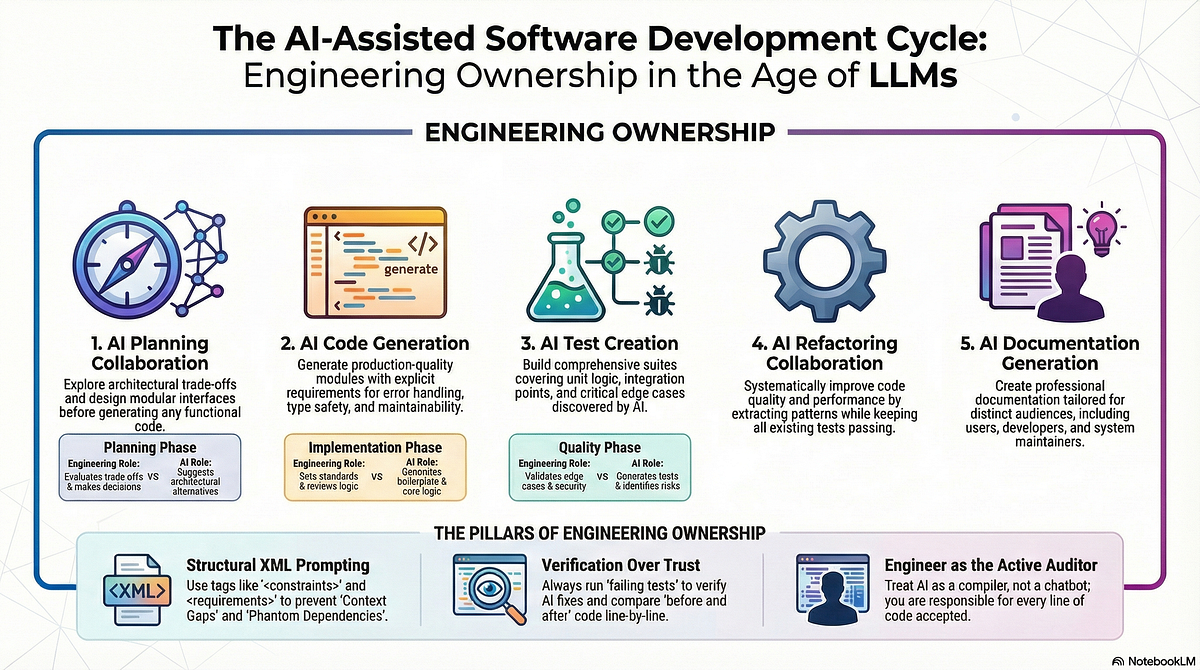
"To successfully build professional-grade applications with Large Language Models (LLMs), we must stop treating them like chatbots and start treating them like compilers. The key to this transition is Structured XML Prompting. In this comprehensive guide, we will walk through the 5 stages of the AI-assisted software development cycle."
"The biggest mistake beginners make is immediately asking the AI to write code. In a professional workflow, we first use AI as a sounding board to explore architectural alternatives, evaluate trade-offs, and design clear module interfaces. A critical rule of AI engineering is: never accept the AI's first suggestion blindly."
"To prevent this, you must generate one module at a time. We use strict constraint structures with tags like allowed_libraries, forbidden_approaches, and complexity_limits to define the AI's operational boundaries."
Professional software development with LLMs requires abandoning conversational approaches in favor of treating AI systems like compilers. The solution is Structured XML Prompting, which enforces engineering discipline through five development stages. Stage 1 involves architectural planning where AI serves as a sounding board for exploring design alternatives and trade-offs rather than immediately generating code. Stage 2 focuses on safe code generation using strict XML constraint structures with tags like allowed_libraries, forbidden_approaches, and complexity_limits to prevent hallucinations and over-engineering. This methodology combines Engineering Ownership principles with rigid XML templates to transform vague requests into bulletproof technical specifications, ensuring AI generates appropriate, maintainable code.
#llm-code-generation #structured-xml-prompting #ai-engineering-best-practices #hallucination-prevention #software-development-workflow
Read at Medium
Unable to calculate read time
Collection
[
|
...
]