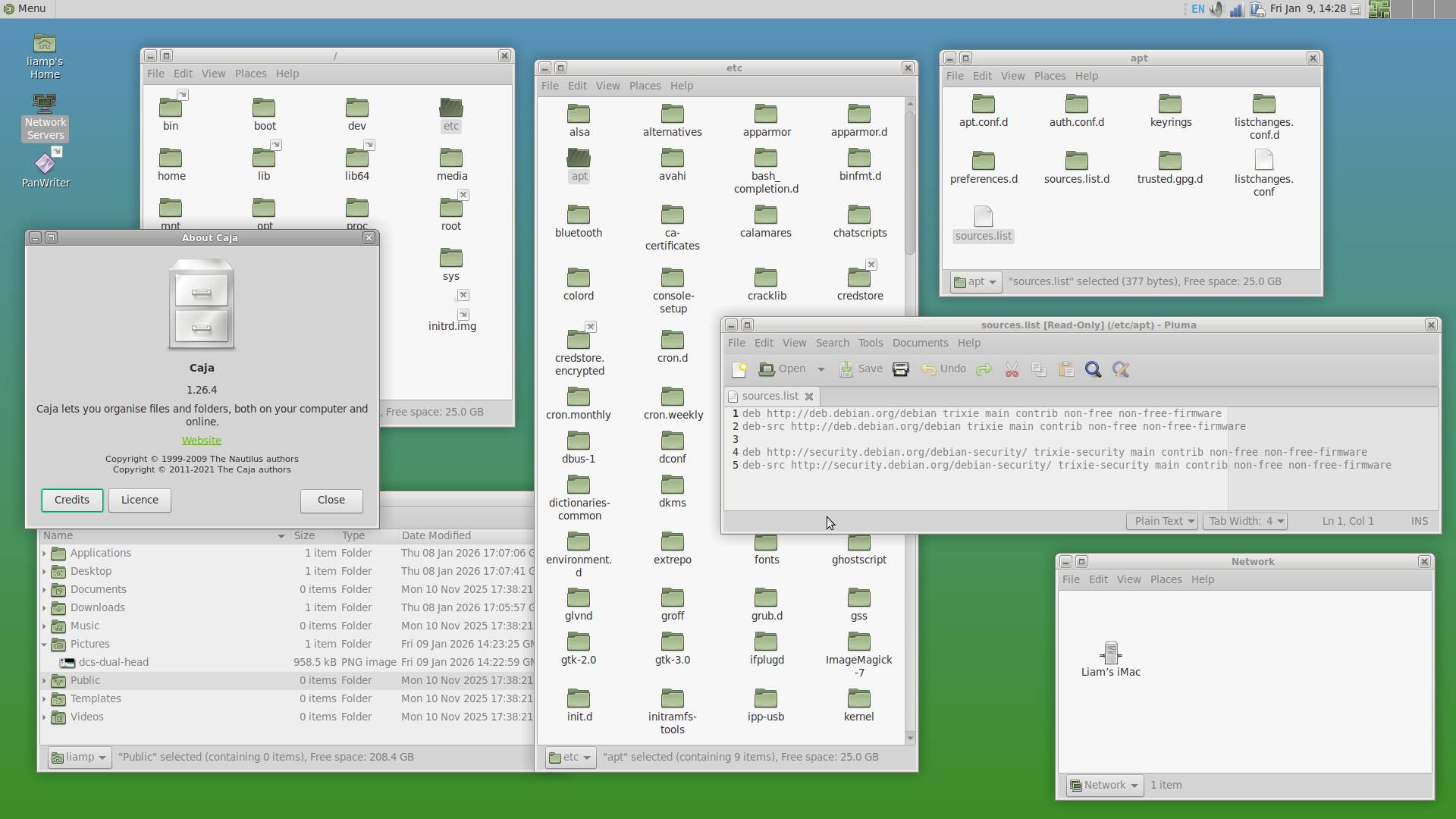
"The Desktop Classic System is a rather unusual hand-built flavor of Debian featuring a meticulously configured spatial desktop layout and a pleasingly 20th-century look and feel. DCS, as project creator "Mycophobia" calls it, has been around in one form or another since 2023, but it came to the attention of The Reg FOSS desk thanks to mentions on the Lobste.rs community and a few days later on OSnews."
"There's no ISO image available, just a ZIP file containing the files needed to put on a blank FAT32 USB key to make it bootable. Incidentally, merely copying some files onto a FAT32 volume isn't enough to make it bootable using a traditional BIOS - so this is a distro only for installation on real hardware that has UEFI firmware. As a side effect, it will be significantly tricky to try it out in a VM."
"We tried it on both new and old Reg FOSS desk testbeds: a modern Dell XPS 13, with a USB-C external display, and a retro ThinkPad W520 with an Nvidia switchable second GPU, which needs version 390 or earlier of the Nvidia binary driver, so it's unsupported on anything newer than kernel 6.4 or so. It ran fine on both; although it was very slow to start on the ThinkPad, once booted it became snappy and responsive."
"The distro is a very stripped-back copy of Debian 13 "Trixie" with a customized MATE setup - the stock MATE 1.26 that Debian 13 provides. The distro is very bare. There are no additional apps, not even Firefox. There's only a mostly empty top panel, without the usual window buttons. It takes about 6 GB of disk and idles at under 800 MB of RAM in use. It's not a cut-down lightweight distro, it's just Debian with no extras at all."
Desktop Classic System is a hand-built minimalist spin of Debian 13 'Trixie' using the stock MATE 1.26 configured for spatial desktop operation. Distribution is delivered as a ZIP with files for a blank FAT32 USB key rather than a traditional ISO, boots only on UEFI-equipped hardware, and is difficult to run in virtual machines because simple file copying to FAT32 is insufficient for BIOS boot. The image omits typical extras: no Firefox and very few applications, a mostly empty top panel, and no window buttons. The build occupies about 6 GB of disk and idles under 800 MB RAM. Performance proved acceptable on modern and older hardware, though boot can be slow on legacy machines.
Read at Theregister
Unable to calculate read time
Collection
[
|
...
]