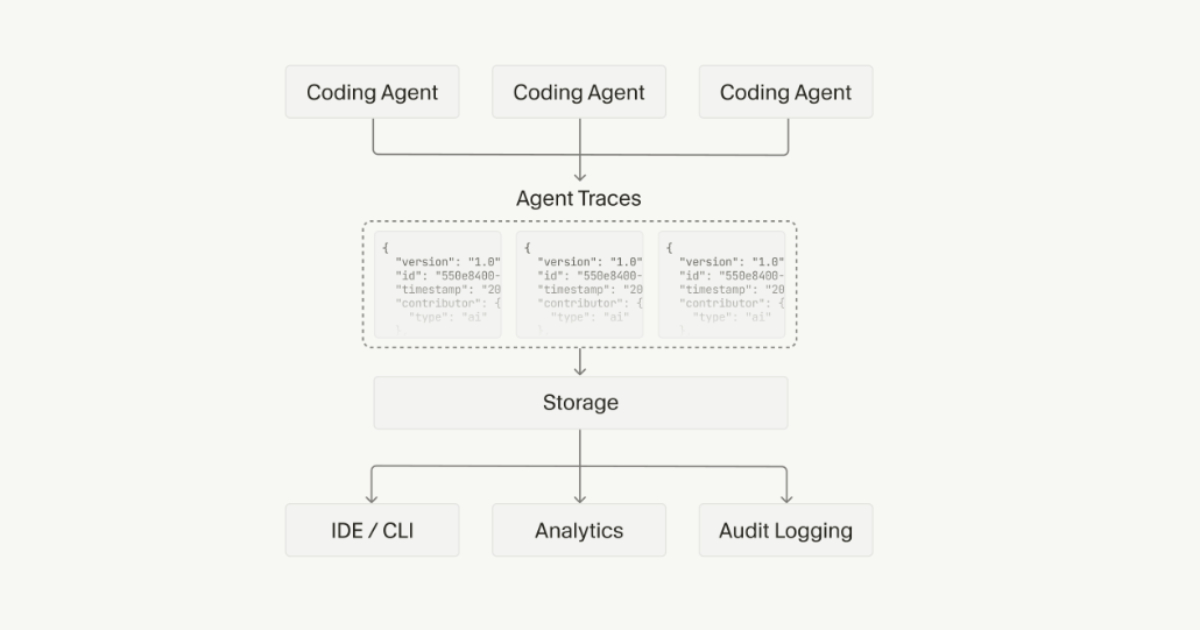
"Agent Trace is a data specification that uses a JSON-based "trace record" to connect code ranges to the conversations and contributors behind them. Contributions can be tracked at the file or line level, categorized by conversation, and classified as human, AI, mixed, or unknown. The schema allows for optional model identifiers for AI-generated code, facilitating precise attribution without being linked to a specific provider."
"Agent Trace also supports multiple version control systems, including Git, Jujutsu, and Mercurial, and introduces optional content hashes to help track attributed code even when it is moved or refactored. Extensibility is a core design goal. Vendors can attach additional metadata using namespaced keys without breaking compatibility, and the spec avoids defining UI requirements or ownership semantics. It also does not attempt to assess code quality or track training data provenance, focusing narrowly on attribution and traceability."
Agent Trace defines a vendor-neutral, JSON-based trace record schema that links code ranges to conversations and contributors for precise attribution. Contributions can be assigned at file or line level and classified as human, AI, mixed, or unknown, with optional model identifiers for AI outputs. The specification is storage-agnostic, permitting records to live as files, git notes, database entries, or other mechanisms, and supports multiple VCS including Git, Jujutsu, and Mercurial. Optional content hashes help track code through moves and refactors. Extensibility allows namespaced vendor metadata while the spec intentionally avoids UI, ownership, code quality assessment, and training-data provenance obligations.
#ai-generated-code-attribution #trace-record-json #version-control-compatibility #extensibility--metadata
Read at InfoQ
Unable to calculate read time
Collection
[
|
...
]