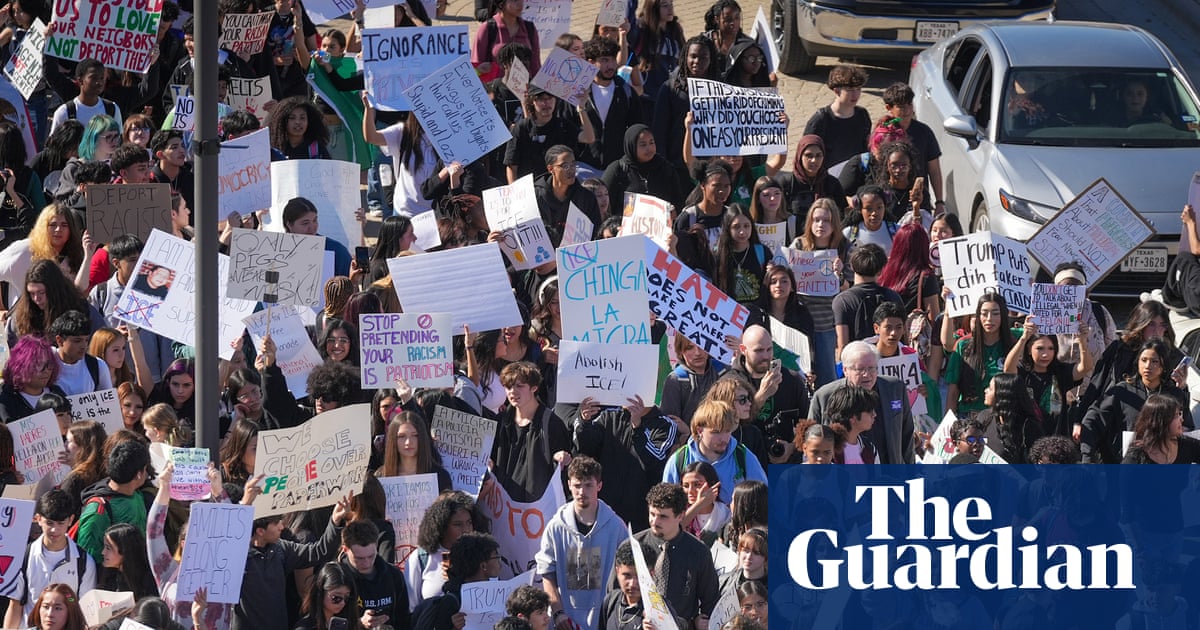
"Lark: This was our way to make our voices heard, because at the end of the day, we're 16 what we say isn't going to make the lawmaker listen to us."
"Kiran: Our school population is majority Hispanic, and those are the people who are racially profiled by ICE, so it's this huge fear. Lots of people in my family are immigrants, lots of people in my family are scared of what's going on. Ethiopian immigrants, people in my family, we aren't Hispanic. So when I am protesting and speaking out against ICE, I'm not just thinking about my family, because I know my family has some level of privilege against what ICE is doing. I'm really trying to think about all the other people who don't have that privilege, who are losing their lives."
"Many said their organizing went beyond leaving class, extending to checking social media for suspected ICE sightings, distributing know your rights materials and making political posters."
Thousands of students walked out of schools over six months to protest ICE presence in their communities. School responses varied: some supported protests, some threatened discipline, and some stayed neutral to avoid drawing attention to vulnerable immigrant students. Student organizing included checking social media for suspected ICE sightings, distributing know-your-rights materials, and making political posters. Organizers proceeded despite personal and family risk, with some leaders explicitly refusing to ask permission from adults. Students connected protest actions to protecting family and community members who face racial profiling and unequal vulnerability to ICE enforcement.
Read at www.theguardian.com
Unable to calculate read time
Collection
[
|
...
]